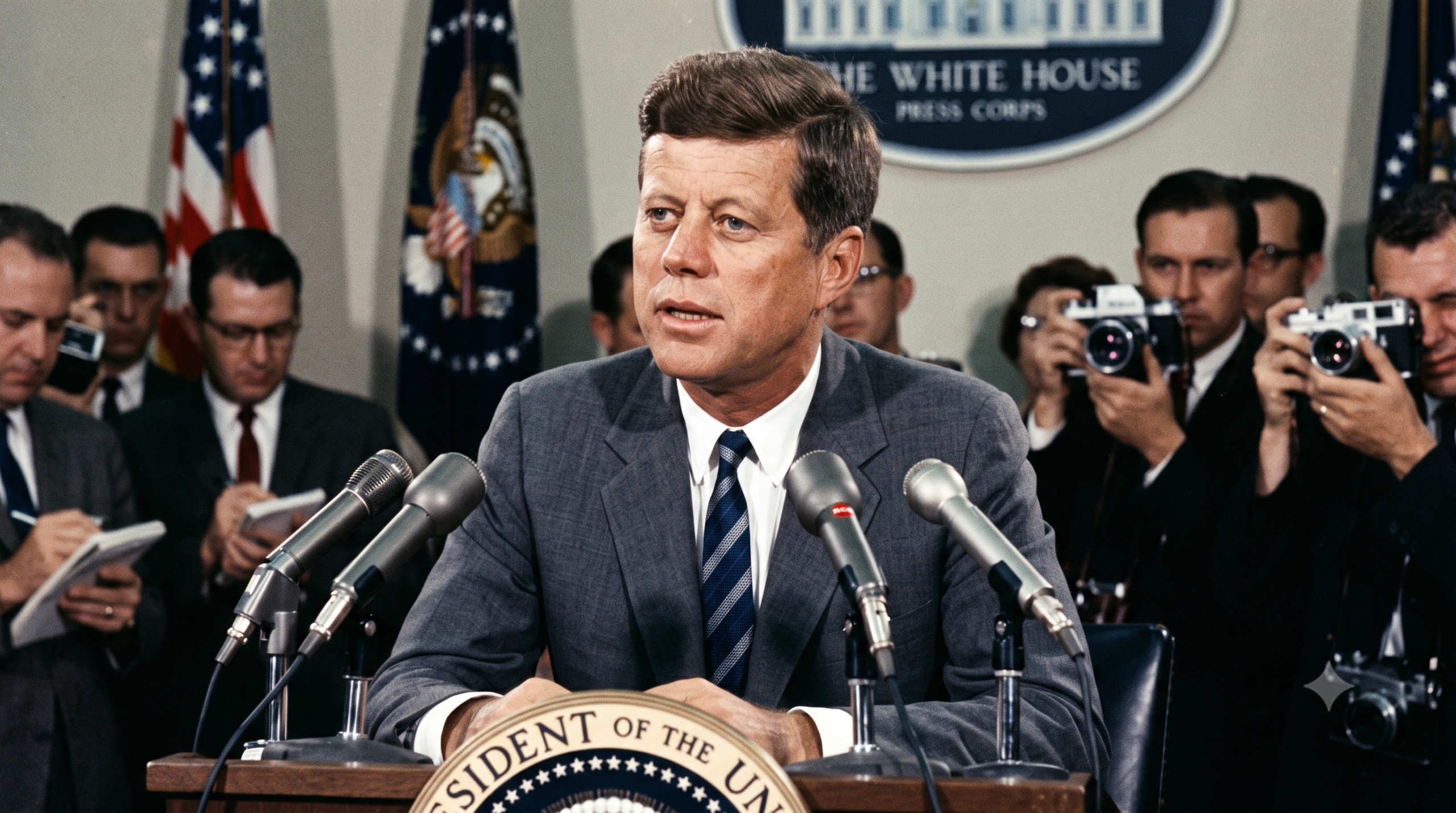
The Myth of Camelot Facing Hard Cold Reality
Welcome to an extraordinary historical exclusive. Today, we peel back the polished layers of American mythmaking to confront one of the most enigmatic figures of the twentieth century. Our guest is none other than John F. Kennedy, the thirty-fifth President of the United States.
While his presidency remains frozen in time as a glittering “Camelot,” behind the glamorous facade lies a web of deep geopolitical miscalculations, high-stakes military gambles, and intense personal secrets.
In this special broadcast, Interrogator cuts through the decades of nostalgic reverence. We will press the former president on the disastrous Bay of Pigs invasion, his reckless private life, and the escalating conflict in Vietnam. Consequently, you will see a deeply human, fiercely pragmatic leader defending a legacy that history continues to fiercely debate. Here is the full transcript of this uncompromising, provocative, and revelatory encounter.
Confronting the Disasters of the Cold War
Interrogator: Mr. President, let us begin with the brutal reality of your early foreign policy. You entered the White House promising a new generation of tough, intelligent leadership. Yet, within months, you authorized the catastrophic Bay of Pigs invasion in Cuba. It was a complete, unmitigated disaster that embarrassed the United States on the global stage. Therefore, how do you answer the charge that your youthful arrogance directly caused this humiliation?
John F. Kennedy: Interrogator, I have never hidden from the bitter lessons of Cuba. Actually, I took complete responsibility for that failure at the time. You must understand that I inherited a fully formed covert operation from the Eisenhower administration. The Central Intelligence Agency assured me that a beachhead landing would spark a popular uprising against Fidel Castro. However, that intelligence was catastrophically wrong. I refused to deploy the American military for an open invasion because I wanted to avoid starting a third world war. Looking back, my mistake was trusting the military planners blindly. We learned from it, and that painful experience is exactly what saved us from nuclear annihilation during the missile crisis later on.
Interrogator: Let us move to that exact crisis in October 1962. The world stood on the very brink of a catastrophic nuclear war. You are often praised for your cool handling of the Soviet threat. However, revisionist historians argue that your aggressive public posturing actually drove the world to the edge. Specifically, you secretly traded away American nuclear missiles in Turkey to secure a deal with Nikita Khrushchev, keeping the American public completely in the dark. Was that brilliant diplomacy, or was it a deceptive cover-up to protect your public image?
John F. Kennedy: History requires a steady hand, not a reckless public display. If we had announced the removal of the Jupiter missiles from Turkey under direct Soviet blackmail, the entire NATO alliance would have collapsed instantly. Khrushchev needed an honorable way to pull his missiles out of Cuba without looking weak to his hardliners in Moscow. Therefore, we gave him a quiet assurance regarding Turkey, which was already scheduled for modernization anyway. It was not a deceptive cover-up; instead, it was a necessary backchannel compromise that successfully prevented a global thermonuclear conflict. Survival matters far more than absolute, immediate public transparency.
The Rising Storm of the Vietnam Conflict
Interrogator: Let us look at Southeast Asia, where your policy was arguably just as perilous. You significantly increased the number of American military advisors in Vietnam from a few hundred to over sixteen thousand. Furthermore, your administration tacitly approved the violent coup against South Vietnamese President Ngo Dinh Diem. Were you not quietly paving the way for a massive, bloody war that would eventually cost over fifty-eight thousand American lives?
John F. Kennedy: We were trying to contain a aggressive communist expansion that threatened the entire region. Diem had become isolated, deeply corrupt, and completely incapable of winning the support of his own people. Consequently, when his own generals decided to overthrow him, we chose not to interfere. I never intended to commit hundreds of thousands of American combat troops to a land war in Asia. In fact, I signed National Security Action Memorandum 263 to begin withdrawing one thousand advisors. Our goal was always to help the South Vietnamese fight their own war, not to fight it for them.
Interrogator: With respect, Mr. President, that sounds like convenient revisionism. Your public statements until your very last days continued to demand a victory against communism in Vietnam. If you truly intended to pull out, why did you keep using such aggressive Cold War rhetoric? Were you simply too terrified of looking soft on communism before the 1964 presidential election?
John F. Kennedy: A politician must always manage the domestic political climate. If I had announced a total, unconditional withdrawal in 1963, the conservative opposition would have crucified my administration. They would have used it to paralyze every piece of domestic legislation, including our crucial civil rights bills. I needed to maintain a strong anti-communist posture publicly while quietly working toward a diplomatic solution. Leadership often means balancing long-term strategic goals with immediate political survival.
Style, Substance, and the Civil Rights Crisis
Interrogator: Let us shift our focus to your domestic record, which many critics describe as long on style but incredibly short on actual substance. You spoke beautifully about equality and freedom. Despite the grand rhetoric, you repeatedly delayed introducing major civil rights legislation because you feared losing the votes of powerful Southern Democrats. Did you value your political alliance with segregationists more than the actual lives of African Americans?
John F. Kennedy: That is a harsh, unfair mischaracterization of a incredibly delicate legislative reality. I deeply believed in the moral necessity of civil rights. However, introducing a massive civil rights bill early in my term would have achieved absolutely nothing. It would have been filibustered and killed immediately by the Southern bloc in Congress. We chose to act decisively through executive power first. We sent federal troops to integrate the University of Mississippi and the University of Alabama. Once the public conscience was fully awakened by the events in Birmingham, we introduced the historic Civil Rights Act. It was not a lack of commitment; it was a calculated strategy to ensure the bill actually passed.
Interrogator: You mention your legislative strategy, but your domestic agenda was largely stalled in Congress before your death. Your tax cuts were blocked, your anti-poverty programs were going nowhere, and your education bills were failing. Was the glamorous “Camelot” image simply a brilliant public relations exercise designed to mask a deeply ineffective presidency?
John F. Kennedy: Change in a democracy is always slow, frustrating, and messy. We were challenging decades of entrenched conservative power in Congress. We laid the essential groundwork for the New Frontier, which aimed to revitalize our economy and protect the vulnerable. My successor, Lyndon Johnson, was able to pass those bills precisely because we had built the necessary national momentum and altered the political conversation. Our style was not a hollow mask; it was a powerful tool used to inspire the nation to reach for grander goals, like putting a man on the moon.
Private Conduct and the Burden of Secrets
Interrogator: Mr. President, we must confront the dangerous dichotomy between your public image as a devoted family man and your reckless private life. You engaged in numerous extramarital affairs inside the White House, including relationships with an associate of a notorious mafia boss and a suspected East German spy. Did you never stop to think that your private compulsions left you completely vulnerable to blackmail, thereby compromising the national security of the United States?
John F. Kennedy: I separate my private life completely from my public responsibilities as leader of the free world. Did my personal actions ever affect my judgment during the Cuban Missile Crisis or my decisions regarding the nuclear test ban treaty? Absolutely not. I operated under immense, unrelenting physical pain every single day due to my back injuries and Addison’s disease. I pushed myself to the absolute limit to serve this country. While my personal choices may shock modern sensibilities, they never once compromised my total dedication to protecting the United States.
Interrogator: Your health is another area shrouded in deep deception. Your administration went to extraordinary lengths to hide your severe medical conditions from the electorate. You took a heavy daily cocktail of steroids, painkillers, and amphetamines just to function. Do you truly believe it was ethical to conceal these debilitating illnesses from the voters who trusted you with the nuclear codes?
John F. Kennedy: The American people need a president who projects strength, confidence, and absolute vitality. If we had published my complete medical records in 1960, the country would have been consumed by unnecessary panic and doubt. Furthermore, our foreign adversaries would have viewed my illnesses as a sign of fatal weakness. What truly matters is that my mind remained sharp, clear, and fully focused during every single crisis. My medical team managed my pain effectively, allowing me to execute the duties of my office without interruption. The results of my presidency speak far louder than any medical chart ever could.
The Weight of a Fragmented Legacy
Interrogator: Your presidency was cut short in a single, tragic moment in Dallas. Since that day, your legacy has been heavily protected by an army of grieving family members, loyal biographers, and romantic myths. When we strip away the attractive veneer of youth, charisma, and tragedy, what is left of your actual achievements?
John F. Kennedy: What remains is a nation that learned to look forward with hope and high ambition. We successfully established the Peace Corps, sending thousands of idealistic young Americans to help developing nations worldwide. We signed the Limited Nuclear Test Ban Treaty, which was the very first step toward slowing down the dangerous global arms race. We set a definitive course for the moon, proving that American ingenuity could achieve the impossible. Most importantly, we successfully steered the world through its most perilous atomic crisis without firing a single shot. A legacy is not just a list of passed bills; it is the enduring spirit you ignite in a country.
Interrogator: Mr. President, thank you for your candor. You remain a fascinating, deeply complicated figure who continues to divide historians and capture the public imagination.
Where Was John F. Kennedy Born?
For history enthusiasts and researchers tracing the roots of American presidency, the question of where was John F. Kennedy born leads directly to a modest, three-story wooden frame house in a Boston suburb (Obleschuk, 1999). On May 29, 1917, the 35th President of the United States, John Fitzgerald Kennedy, was born in the master bedroom of his family’s home located at 83 Beals Street in Brookline, Massachusetts (KENNEDY, n.d.). His parents, Joseph P. Kennedy and Rose Fitzgerald Kennedy, had purchased the Colonial Revival property just a few years prior in 1914, establishing it as the foundational setting for one of America’s most prominent political dynasties (Kennedy, n.d.).
Understanding exactly where was John F. Kennedy born offers valuable insight into his early childhood, as he spent the first four years of his life navigating the tree-lined streets of this suburban neighborhood (Obleschuk, 1999). Local historical records note that the future president was delivered at home—a common preference for Boston women of that era—in a bed positioned precisely near the window to allow maximum natural light for the attending physician (Kennedy, n.d.). Today, anyone looking into where was John F. Kennedy born will find that the property has been preserved as the John Fitzgerald Kennedy National Historic Site (Lowe, 2023). Supervised and restored by his mother, Rose Kennedy, the home stands as a National Historic Landmark, allowing the public to tour the exact rooms where the iconic leader spent his infancy (KENNEDY, n.d.).
What Did JFK Do in World War 2
Understanding the military history of past American presidents often leads researchers and history buffs to ask a pivotal question: what did jfk do in world war 2? Long before he became the 35th President of the United States, John F. Kennedy served as a high-profile officer in the U.S. Navy. Despite suffering from severe, chronic back issues that initially disqualified him from Officer Candidate School, Kennedy used his family’s influence and his own fierce determination to secure a commission as a Lieutenant. He was eventually assigned to the South Pacific theater, where he took command of a patrol torpedo boat known as PT-109, a fast but highly vulnerable wooden craft tasked with intercepting Japanese convoy lines.
The defining moment of his military career occurred on the night of August 2, 1943, offering a definitive answer to what did jfk do in world war 2. While on a nocturnal patrol in the Blackett Strait near the Solomon Islands, the much larger Japanese destroyer Amagiri rammed PT-109, slicing the wooden boat completely in half (White, 2013). The collision killed two crew members instantly and re-injured Kennedy’s fragile back (Kennedy, n.d.). Refusing to abandon his surviving crew, Kennedy gathered the men on the remaining piece of the hull before leading them on a grueling three-mile swim to a tiny, deserted island. Showing profound physical stamina, Kennedy towed a badly burned crewman through the water by clenching the strap of the man’s life jacket between his teeth (White, 2013).
When looking broadly at what did jfk do in world war 2 following the wreck, his leadership over the next week solidified his status as a genuine military hero. Kennedy swam several additional miles into dangerous, enemy-patrolled waters to signal other U.S. vessels for help, and he famously carved a distress message into a coconut shell that was delivered by local Solomon Islander scouts (White, 2013). After their rescue on August 8, 1943, Kennedy actually returned to active duty just a month later, taking command of PT-59 to rescue stranded Marines before being honorably discharged due to his injuries in 1945 (Kennedy, n.d.). Ultimately, discovering what did jfk do in world war 2 reveals how his wartime courage and the widespread media coverage of his survival forged the indomitable “war hero” persona that heavily propelled his future political ascension to the White House (White, 2013).
Why was jfk in dallas in 1963
The overarching question of why was jfk in dallas in 1963 traces back to complex internal political friction within the Democratic Party. During the fall of 1963, President John F. Kennedy noticed a widening, public feud in Texas between conservative Democratic Governor John Connally and liberal U.S. Senator Ralph Yarborough. To project national party unity, secure critical Texas electoral votes, and smooth over these intense factional rivalries before the upcoming election, Kennedy planned a multi-city tour through the Lone Star State.
Beyond party mediation, why was jfk in dallas in 1963 can also be explained by early 1964 presidential reelection campaign strategies. Texas was a vital swing state that Kennedy had barely won in 1960, and he knew he needed a strong showing there to secure a second term against his anticipated Republican opponent, Barry Goldwater. An official, highly visible motorcade through the heart of downtown Dallas was viewed by White House aides as the perfect launchpad to bolster his public approval, connect with local voters, and raise necessary campaign funds.
Finally, looking into why was jfk in dallas in 1963 reveals a specific, policy-driven destination: a scheduled luncheon speech at the Dallas Trade Mart. The President intended to deliver a major address focused on national security, leadership, and the burgeoning aerospace and technology sectors in the region, including a public acknowledgment of the Graduate Research Center of the Southwest. Tragically, as the open-top presidential limousine made its way through Dealey Plaza toward the venue on November 22, the historic motivations behind why was jfk in dallas in 1963 were permanently overshadowed by his assassination.
Recommended Research Links For JFK
-
The John F. Kennedy Presidential Library and Museum
This official archive offers direct access to declassified documents, audio recordings, and primary sources from the Kennedy administration. It is essential for anyone analyzing his Cold War foreign policy decisions.
-
The Miller Center – John F. Kennedy Presidential Profile
This academic resource provides a comprehensive, non-partisan analysis of Kennedy’s presidency. It features detailed breakdowns of both his domestic policy challenges and his hidden medical history.
-
The Foreign Relations of the United States (FRUS) Digital Archives
This official state department collection contains the actual transcripts, memos, and telegrams sent during the Cuban Missile Crisis and the early Vietnam conflict. It is an invaluable tool for exploring the true depth of the JFK legacy debate.
Disclaimer: The interview presented above is a historical simulation. The responses represent what questioninghistory.com believes the person interviewed may have answered if alive today. The dialogue is constructed based on extensive research into John F. Kennedy’s actual speeches, private writings, recorded conversations, and historical memoirs.