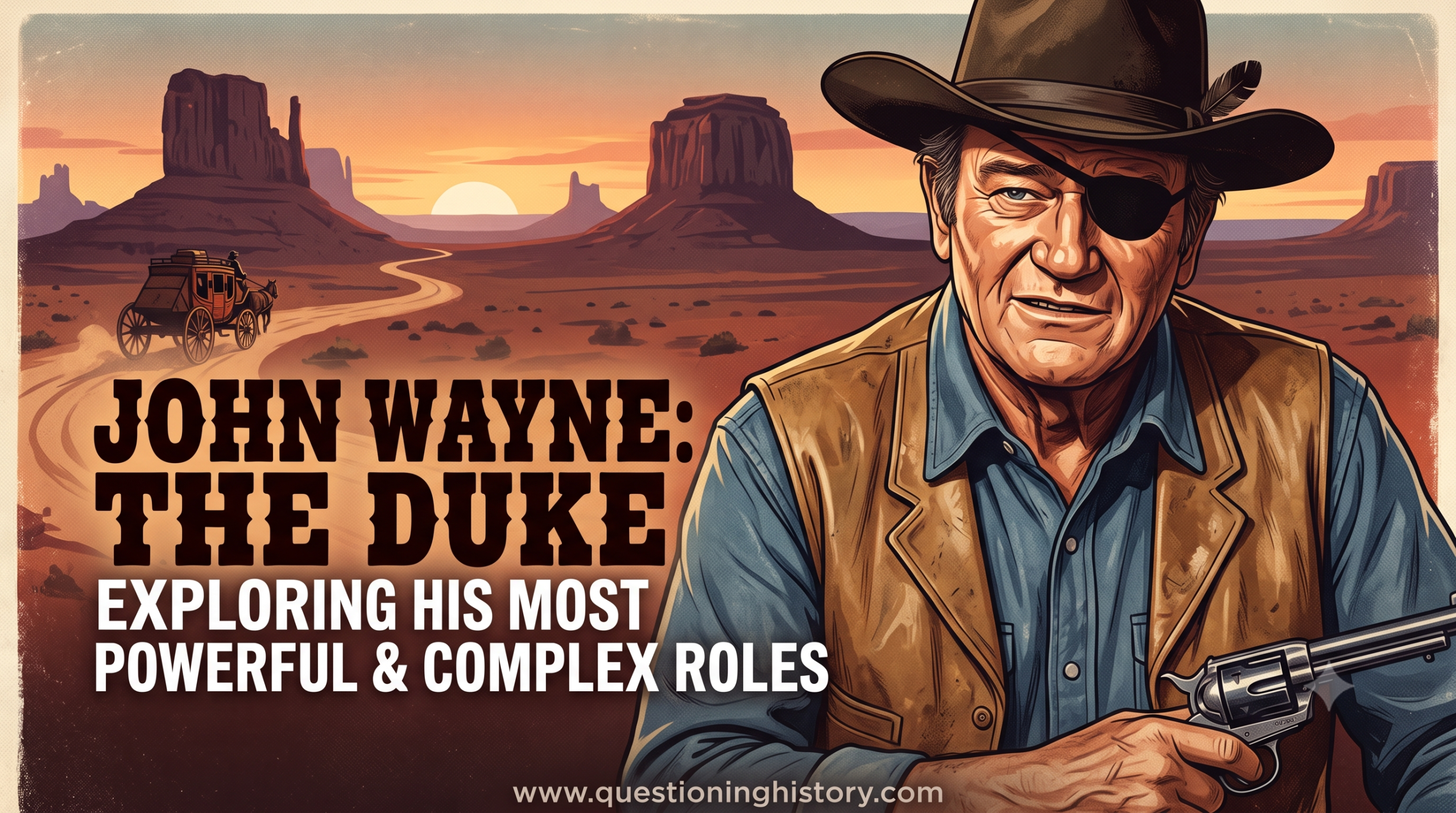
He spent five decades playing men who never flinched, never explained themselves, and never lost. In this imagined interview, we ask John Wayne to do all three anyway — starting with the name on his birth certificate.
From Marion to “Duke”: The Name Behind the Legend
Interrogator: Let’s start at the beginning. Most people don’t realize “John Wayne” isn’t your real name at all.
John Wayne: No, it never was. I was born Marion Robert Morrison, in a little house in Winterset, Iowa, back in 1907. “Marion” followed me around like a burr for years, especially once I got to USC and the football boys needed something to razz me about. The studio changed it to John Wayne before my first big picture, and I never looked back. A cowboy named Marion doesn’t sell many tickets.
Interrogator: Did losing your real name feel like losing a piece of yourself?
John Wayne: Not really, because I kept the parts that mattered. Everybody who mattered to me still called me “Duke,” a name I’d had since I was a boy with a dog by that name trailing behind me. So between the studio’s invention and my own nickname, my actual birth name got crowded out pretty quick. It’s a funny thing, spending sixty years as a man whose real name almost nobody remembers to ask about.
Finding His Footing in the Western
Interrogator: You made your name — the new one, anyway — in Westerns. What drew you to that genre specifically?
John Wayne: Simplicity, mostly. A Western strips a man down to what he actually believes, no telephones, no lawyers, just a horse and a decision. I came up working as a prop man and stuntman before anybody trusted me with real lines, so I learned the genre from the ground floor. By the time John Ford gave me a real shot, I understood exactly what a Western audience wanted from the fellow on the horse.
Interrogator: Some critics say you played the same character in every film. How do you answer that?
John Wayne: I answer it by pointing at the box office, though I understand it stings some critics to hear that. I did shade the character depending on the story — softer in some pictures, meaner in others — but yes, audiences wanted a version of that same fellow they trusted. There’s no shame in giving people something steady to hold onto, especially during the years I was working, when the country needed steady more than it needed variety.
Rio Bravo and the Dean Martin Partnership
Interrogator: Let’s talk about Rio Bravo. That picture is often called a direct answer to High Noon, which you reportedly hated.
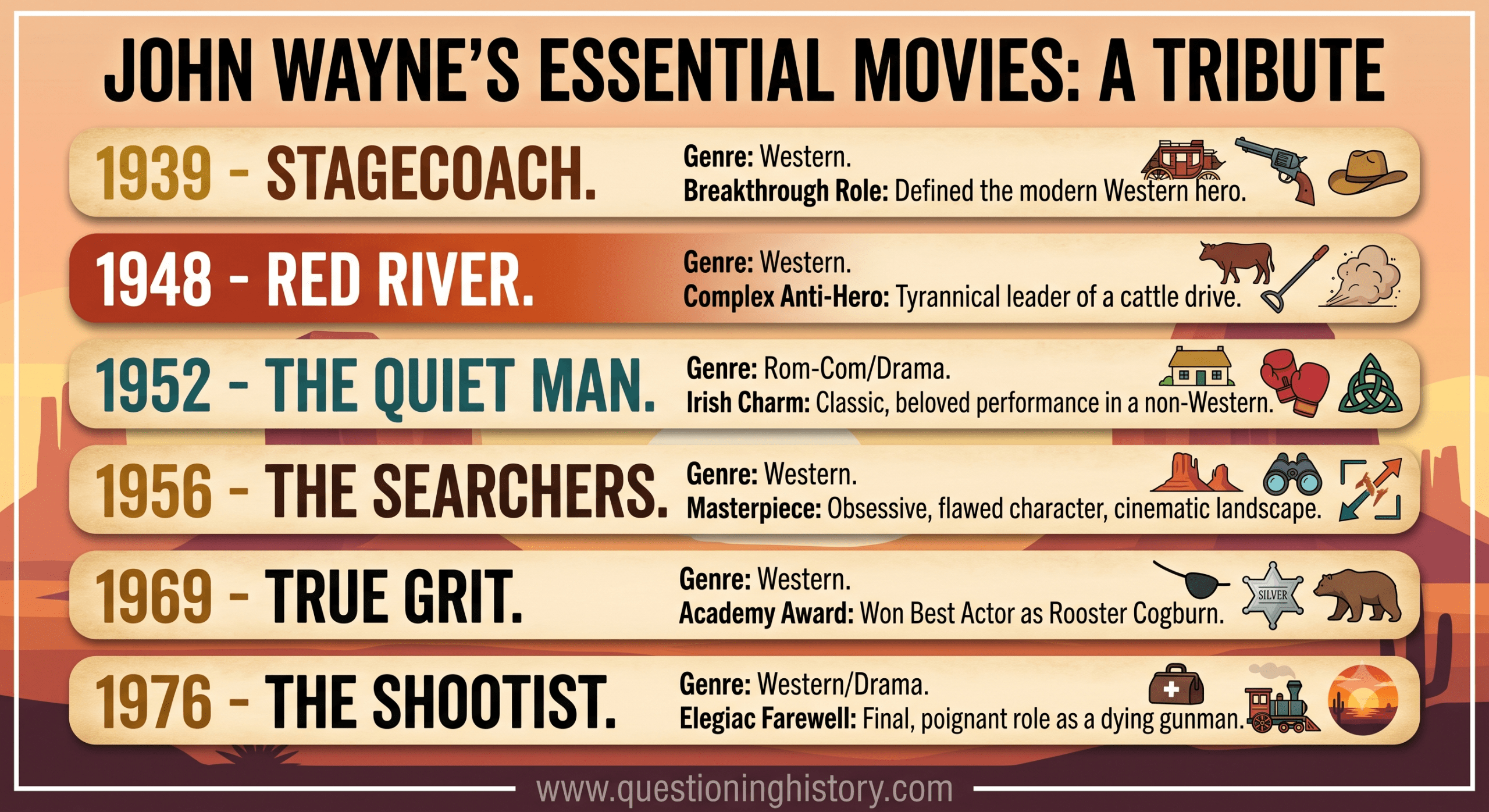
John Wayne: I never cared for the message in that other picture, a town full of grown men too scared to help their own sheriff. So when Howard Hawks came to me with Rio Bravo, I said count me in immediately. We built a story where the lawman doesn’t beg the town for help; he just does his job with the men willing to stand beside him. It became one of the pictures I’m proudest of, and Howard always said it was his favorite too.
Interrogator: That film paired you with Dean Martin, which surprised some people at the time. What was it like making a John Wayne movie with Dean Martin as your co-star?
John Wayne: People expected a crooner to look silly next to me in a gun belt, and Dean proved every one of them wrong. He’d been drinking his way through a rough patch in his career, and playing a drunk deputy trying to claw back his self-respect wasn’t much of a stretch for him emotionally. He showed up ready to work, hit his marks, and never once tried to steal a scene that wasn’t his. We got along fine, on and off the set, and I’d have made another picture with him in a heartbeat.
Interrogator: Did you know at the time that Rio Bravo would hold up the way it has?
John Wayne: You never know that at the time, not really. We just knew we liked the script and we liked each other’s company on set, which counts for a lot on a picture that spends most of its time in one jailhouse. It still pleases me that people talk about that film the way they do all these years later, especially the parts with Dean.
Becoming Rooster Cogburn
Interrogator: Let’s move ahead a decade to True Grit. You finally won an Academy Award for playing Rooster Cogburn. What took the Academy so long?
John Wayne: I’ve wondered that myself, plenty of times, usually with a drink in my hand. I made pictures they still study — Stagecoach, Red River, The Searchers — and never got so much as a nomination for most of them. Rooster Cogburn was a fat, one-eyed old marshal with a bad attitude and a worse liver, and somehow that’s the fellow who finally got me the statue. I told the crowd that night if I’d known an eyepatch would do the trick, I’d have worn one thirty-five years earlier.
Interrogator: Was there something in Rooster Cogburn that felt closer to who you actually were, off screen?
John Wayne: More than in most of my parts, probably. Rooster was ornery, a little past his prime, and not particularly graceful about admitting he still had some fight left in him. I understood that fellow. By the time I played him I’d buried friends, survived a fair share of my own bad decisions, and I brought all of that into the role whether I meant to or not. The Academy called it a career award, and maybe it partly was, but I still think Rooster earned his own way in.
The Legacy of the Man in the Hat
Interrogator: Looking back across everything, from Marion Morrison in Winterset to the Duke on movie screens everywhere, how do you want people to remember you?
John Wayne: As a fellow who showed up and did the work, mostly. I wasn’t the most naturally gifted actor to ever step in front of a camera, and I never pretended otherwise. But I understood what people needed from a picture, and I gave it to them for close to fifty years without much complaint. If a kid watching Rio Bravo or True Grit today walks away believing a man can be tough and decent at the same time, I’ll consider that a job well done.
Interrogator: Any regrets about the name change, all these years later?
John Wayne: None worth mentioning. Marion Morrison was a fine Iowa boy, but John Wayne is the fellow who got to do all the living. I’ve made my peace with that trade a long time ago.
Whether you see him as a genuine American icon or a carefully constructed screen persona, John Wayne’s hold on the Western has never really loosened.
Further Reading
- John Wayne Birthplace & Museum — the only museum dedicated entirely to Wayne, located in his birth home in Winterset, Iowa, with details on his birth name and early life.
- National Cowboy & Western Heritage Museum: John Wayne — an institution holding a significant collection of Wayne’s personal artifacts and family history.
- Library of Congress: Rio Bravo Named to the National Film Registry — the Library of Congress’s own announcement explaining why Rio Bravo was preserved as culturally and historically significant.
Disclaimer
This interview is a fictional reconstruction. It reflects what questioninghistory.com believes John Wayne might plausibly have said if he were alive today, based on historical research. It is not a real or verified interview.