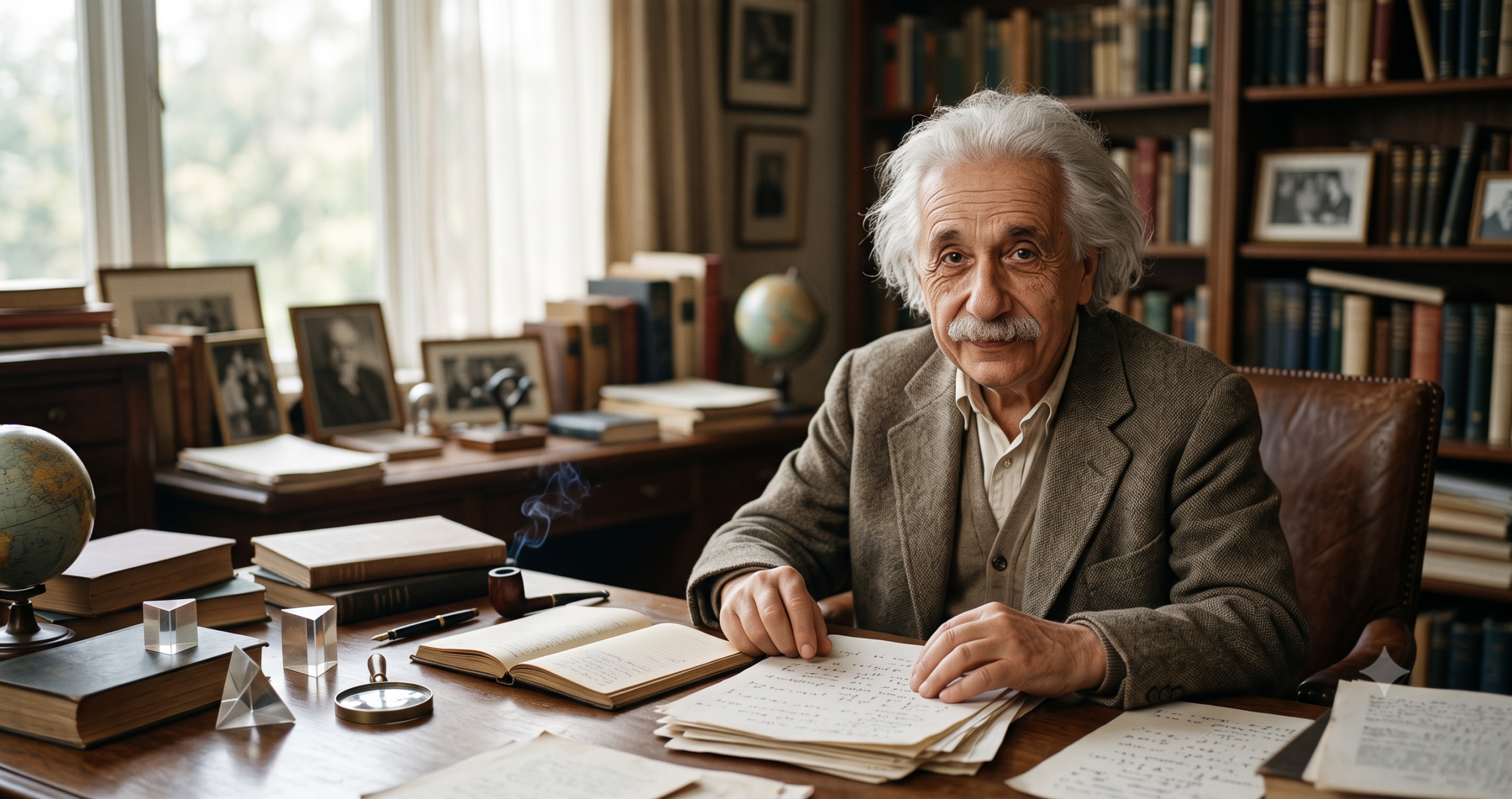
Albert Einstein Biography: A Fictional Interview on Genius, War, and Death
Few names carry the weight that Albert Einstein’s does. This piece digs into the Albert Einstein biography most people only know in fragments — the wild hair, the equation, the Nobel Prize — and lets him answer questions in his own blunt, dryly funny style. None of this is a transcript. It’s an informed reconstruction, built from letters, biographies, and his own recorded words, imagining what he might say if he sat across the table today.
Early Life and the Patent Clerk Who Rewrote Physics
Interrogator: Let’s start plainly. You couldn’t land a university job after graduating and ended up examining patents in Bern. How does a clerk end up rewriting physics on his lunch break?
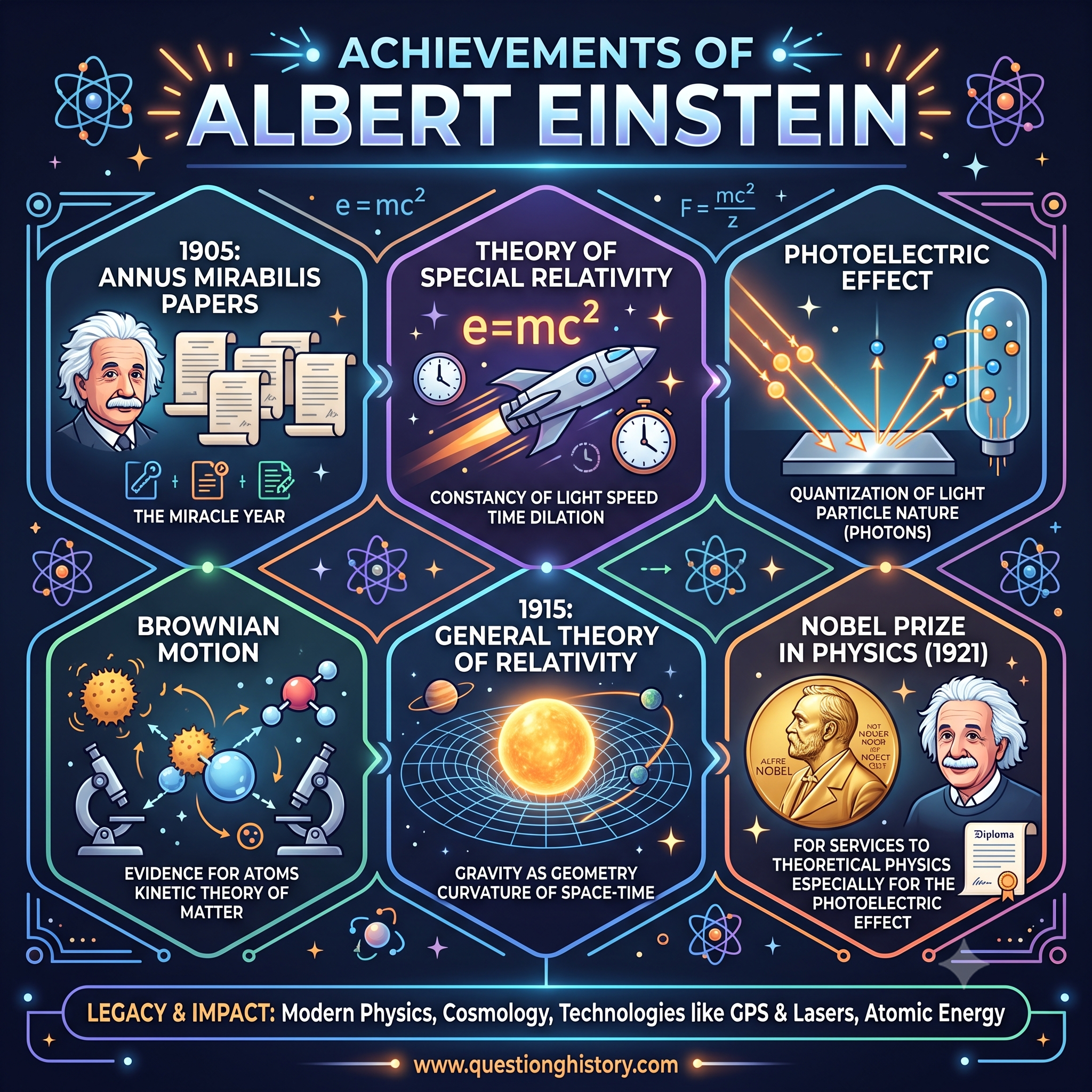
Albert Einstein: Because nobody was watching me. That’s the honest answer. The professors who rejected me wanted a young man who agreed with them. I wasn’t that young man. At the patent office, I evaluated other people’s machines all day, and it trained me to ask one question constantly: does this actually work, or does it only look like it works on paper? I asked physics the same question. In 1905 alone, I answered it four times.
Interrogator: Your school records describe a boy who resisted rote learning and clashed with teachers. Was that rebellion, or something else?
Albert Einstein: Call it allergic reaction. German schooling in my day ran on obedience and memorization, and I had neither talent nor patience for either. A teacher once told me I would never amount to anything because I asked too many questions in class. Meanwhile, I was already teaching myself geometry from a book my uncle gave me. Authority for its own sake bores me. It always has.
Why Is Albert Einstein Famous? Relativity, Light, and a Prize He Almost Missed
Interrogator: For readers who only know the name, why is Albert Einstein famous — in your own words, not the textbook version?
Albert Einstein: Because I showed that space and time bend depending on how fast you’re moving, and that mass and energy are two faces of the same coin. E equals mc squared looks simple on a mug, however it rewired how humanity understands the universe. Before 1905, space was a fixed stage and time ticked the same everywhere. I proved otherwise. That single shift is probably the real answer to why is Albert Einstein famous, more than any photograph of me sticking out my tongue.
Interrogator: You won the Nobel Prize in 1921, but not for relativity — for the photoelectric effect. Did that sting?
Albert Einstein: A little, yes, though I understood it. The committee found relativity too controversial to certify, so they picked the safer paper. In fairness, the photoelectric work opened the door to quantum theory, which turned out to be just as strange as anything I did with time and gravity. I’ve joked that I got the prize for the wrong discovery. Still, a prize is a prize, and Mileva got the money as part of our divorce settlement, which I’d promised her years before I actually won it.
The Bomb, Pacifism, and a Letter He Wished He Never Sent
Interrogator: You signed a 1939 letter urging Roosevelt to pursue atomic research, fearing Germany would get there first. Given your reputation as a pacifist, how do you square that?
Albert Einstein: I don’t fully square it, and I never pretended to. Fear made me sign that letter — fear that Hitler’s scientists would build the bomb alone and use it without hesitation. I never touched the Manhattan Project itself; the government considered me a security risk and kept me away from it. Afterward, when Hiroshima happened, I called that letter the greatest mistake of my life. Pacifism is a principle. War is a circumstance. Sometimes they collide, and you live with the wreckage.
Interrogator: You co-wrote “Why War?” with Freud years before that letter, arguing for disarmament and international cooperation. Does that essay still hold up, in your view?
Albert Einstein: The diagnosis holds up better than the cure, unfortunately. Freud and I agreed that aggression sits deep in human nature and that institutions can restrain it, even if they can’t erase it. What neither of us predicted was a weapon capable of ending civilization in an afternoon. As a result, after 1945 I spent my remaining years pushing for world government and nuclear control because the old arguments for peace suddenly carried a much shorter deadline.
Rivals, Marriages, and a Reputation for Being Difficult
Interrogator: Your long dispute with Niels Bohr over quantum mechanics became legendary — “God does not play dice,” and so on. Was that rivalry personal or purely scientific?
Albert Einstein: Purely scientific, though it got heated enough to look personal from the outside. Bohr believed the universe runs on probability at its core. I never accepted that; I thought quantum theory was incomplete, not final, and I spent decades trying to poke holes in it with thought experiments. He usually patched them. We respected each other enormously, even while disagreeing on nearly everything. In contrast to how people imagine feuds, ours was closer to two stubborn friends who never stopped arguing at dinner.
Interrogator: Your personal life gets less flattering coverage — the affair that ended your marriage to Mileva, a difficult relationship with your sons, your son Eduard’s institutionalization. Do you accept the “difficult man” label?
Albert Einstein: I accept most of it. I was not an attentive husband, and my mind was often somewhere else entirely — usually chasing an equation instead of a family. Mileva and I loved each other once, genuinely, before the marriage collapsed under my absence and my infidelity with Elsa. Eduard’s illness devastated me, and I have no tidy explanation for how little I was present for him. Genius doesn’t excuse neglect. I simply wasn’t built for domestic life the way some men are.
Legacy and How Did Albert Einstein Die
Interrogator: Israel offered you the presidency in 1952, largely symbolic but still a real offer. Why turn it down?
Albert Einstein: Because I understood equations, not statecraft. I told them plainly that I lacked the natural aptitude and the experience to deal with human affairs at that level. Politics requires a kind of tact I never mastered — I say what I think, and diplomacy usually suffers for it. Besides, I believed I could serve the Jewish people better as a scientist and a voice for peace than as a head of state juggling budgets and borders.
Interrogator: Last question, and it’s the one people search for most: how did Albert Einstein die, and did you have any say in how it happened?
Albert Einstein: I did, actually. An aortic aneurysm had been growing for years, and by April 1955 it ruptured in Princeton. Surgeons offered to operate. I refused. I’d said before that I wanted to go when I chose, elegantly, and that artificially prolonging life felt tasteless to me. I died on April 18, 1955, at seventy-six. Afterward, a pathologist removed my brain without my family’s permission, hoping to find the source of my thinking in the tissue itself. He never did. The answer to how did Albert Einstein die is simple; what happened to my brain afterward is the stranger story.
Closing Thoughts
Ninety minutes with a man who’s been gone for seventy years is, of course, impossible. What this exercise offers instead is a way to hold his contradictions side by side — the pacifist who helped start the nuclear age, the rebel who won the world’s most establishment prize, the genius who couldn’t manage his own household. Reading through his letters and biographies, one thing stands out: he never asked to be worshipped, only to be questioned. This piece just took him up on it.
Disclaimer: This interview is a fictional reconstruction. It reflects what questioninghistory.com believes Albert Einstein might plausibly have said if he were alive today, based on historical research. It is not a real or verified interview.
Further Reading
- Nobel Prize official biography — the Nobel Foundation’s own account of his path from patent clerk to laureate, written close to the time of the award.
- Britannica: Albert Einstein — a thorough, regularly updated academic overview covering his science, politics, and personal life.
- The Official Website of Albert Einstein — maintained in connection with his estate, with biographical detail, quotes, and archival material.