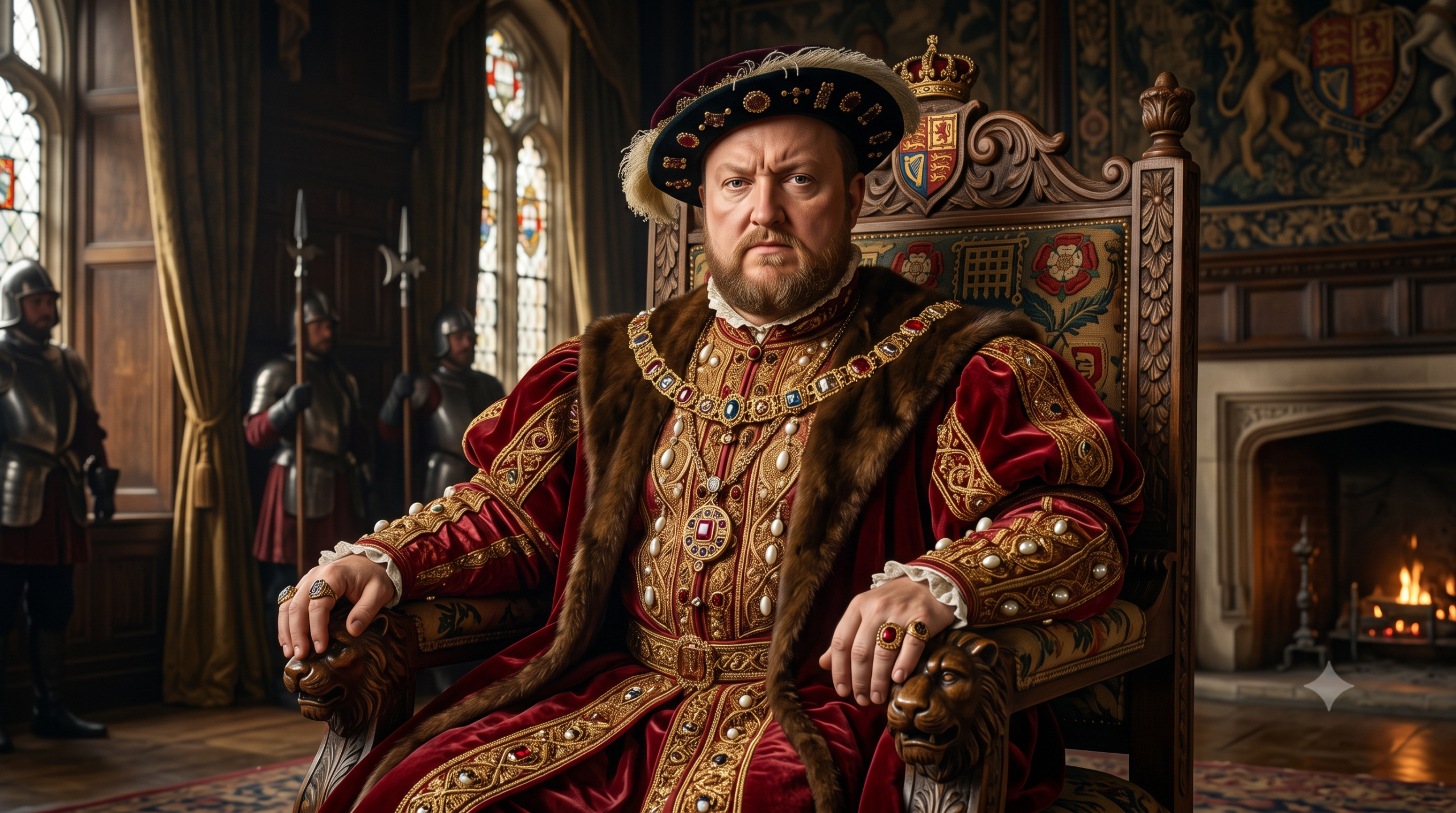
Confronting the King: An Exclusive Interview with Henry VIII
Welcome to our historical interrogation series. Today, we sit down with the most notorious Tudor monarch to uncover the real motivations behind his tumultuous reign. Why did he break ties with the Pope, and what drove his infamous matrimonial choices?
Let’s step into the interrogation room with King Henry VIII.
Inside the Mind of England’s Most Powerful Monarch
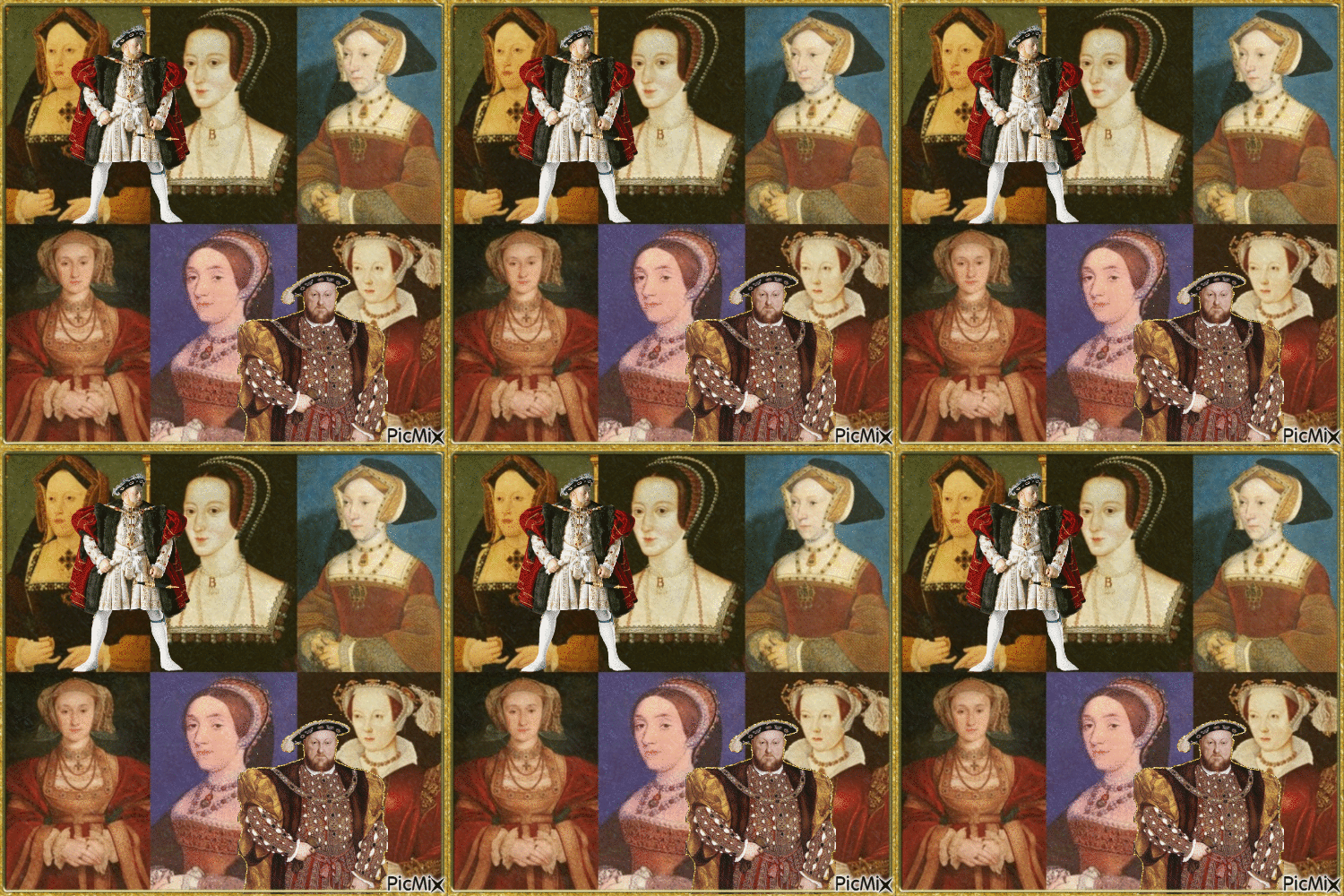
Interrogator: Your Majesty, let us begin by looking directly at the sheer chaos of your personal life. People today look back at your reign and see a tyrant driven purely by lust and ego. Specifically, they point to the infamous list of henry 8 wives in order as proof of your instability. How do you defend your marital record?
Henry VIII: Firstly, you must understand that my primary duty was never personal pleasure. Instead, it was the absolute security of the English realm. Therefore, securing a male heir was a matter of life and death for the Tudor dynasty. If you examine the list of henry 8 wives in order, you will notice a desperate quest for political stability. Catherine of Aragon failed to give me a surviving son. Consequently, I had to look elsewhere, leading to Anne Boleyn, Jane Seymour, Anne of Cleves, Catherine Howard, and Catherine Parr.
Interrogator: You speak of political stability, yet your actions brought massive religious upheaval. Historians constantly debate a central question: why did henry viii break with rome so violently? Was it truly a matter of religious conscience, or was it simply because the Pope refused to grant your annulment?
Henry VIII: To be completely frank, the Pope was acting as a political prisoner of Holy Roman Emperor Charles V. As a result of this alliance, Rome could not grant me justice. Thus, the question of why did henry viii break with rome is answered by sovereignty. I am a king, accountable only to God Almighty. Consequently, I could not allow a foreign bishop in Italy to dictate the succession of the English crown.
What Did the Act of Supremacy 1534 Cost England?
Interrogator: Let us move to the legislative engine of your revolution. In order to cement your supreme authority, you introduced the historic act of supremacy 1534. By forcing this law through Parliament, you essentially made yourself the pope of England. Was this not a massive, blasphemous power grab?
Henry VIII: Absolutely not, because I merely reclaimed what was historically mine. Specifically, the act of supremacy 1534 did not grant me new spiritual powers. Rather, it recognized the ancient imperial status of the English monarchy. Furthermore, the English church had been corrupted by foreign financial demands. Through the legal power of the act of supremacy 1534, we restored the rightful hierarchy. I became the Supreme Head on earth of the Church of England, directly under God.
Interrogator: Nevertheless, that very law led directly to the execution of your closest friends. Sir Thomas More and Bishop John Fisher refused to accept your absolute supremacy. How do you sleep at night knowing you sent such brilliant, holy men to the scaffold for their faith?
Henry VIII: Their deaths were undeniably tragic, but treason cannot be tolerated under any circumstances. Moreover, their primary loyalty belonged to Rome instead of England. When a subject refuses to swear to the legal succession, they become an active threat. Therefore, despite my personal affection for More, the law had to be enforced. A king who shows weakness to traitors will soon find his kingdom consumed by civil war.
Why Did Henry VIII Break With Rome?
Interrogator: Let us dig deeper into the actual mechanics of the English Reformation. Critics argue that the question of why did henry viii break with rome can be answered in one word: money. By dissolving the monasteries, you raked in millions of pounds. Was this whole religious shift just a massive robbery to fund your expensive foreign wars?
Henry VIII: Naturally, the financial benefits were highly advantageous for the crown. However, the monastic system was thoroughly corrupt and failing its spiritual duties. Therefore, redistributing that wealth to defend England against Catholic invaders was entirely justified. If you ask why did henry viii break with rome, you must look at the existential threats we faced. France and Spain were constantly plotting our destruction, so England required substantial fortification.
Interrogator: Let us return to your marriages, which remain a source of endless fascination. When people memorize the henry 8 wives in order, they see a pattern of cruelty. You executed two of them—Anne Boleyn and Catherine Howard. Did you feel any remorse when the axe fell on the women you once claimed to love?
Henry VIII: The crown demands absolute purity, especially from the queen consort. Unfortunately, Anne Boleyn was guilty of high treason through her treasonous behavior. Similarly, Catherine Howard engaged in shameful pre-marital and extra-marital affairs. While it pained my heart deeply, their actions threatened the legitimacy of the royal bloodline. Consequently, justice had to be served swiftly to protect the crown.
Terror and Betrayal at the Tudor Court
Interrogator: Your court was famous for being a dangerous place to work. You relied heavily on brilliant ministers like Thomas Wolsey and Thomas Cromwell. Yet, you destroyed them both the moment they inconvenienced you. Why should history view you as anything other than a ruthless monster who used and discarded people?
Henry VIII: You speak as if these ministers were completely innocent victims. On the contrary, Cardinal Wolsey failed miserably to secure my annulment from Catherine. His failure directly prolonged the national crisis over the succession. Meanwhile, Thomas Cromwell mismanaged the diplomatic alliance with Anne of Cleves. In addition to that blunder, he protected religious extremists who threatened domestic peace. Therefore, their downfall was a direct result of their own gross incompetence.
Interrogator: Let us look at the vast cultural destruction your policies caused. By breaking with the Catholic Church, you destroyed centuries of art, shrines, and libraries. Don’t you realize that the act of supremacy 1534 essentially unleashed an era of state-sponsored cultural vandalism?
Henry VIII: We did not destroy art; rather, we eradicated dangerous superstition and idol worship. For generations, the people were misled by fraudulent relics and false shrines. Through the authority of the act of supremacy 1534, we brought the true Word of God to light. We ordered the Bible to be translated into English for every parish. Consequently, the common people could finally read the scriptures for themselves.
The Legacy of the Ultimate Renaissance Prince
Interrogator: Your final marriage to Catherine Parr seemed to bring some peace to your later years. However, your health was failing dramatically, and your tyranny grew worse. Looking back at the full sequence of henry 8 wives in order, do you regret the pain you inflicted on your family?
Henry VIII: My only regret is that the path to stability was so painfully difficult. Fortunately, my final queen was a comforting companion who helped unite my children. Thanks to those painful struggles, I left behind three capable heirs to the throne. Mary, Elizabeth, and Edward each had a clear right to rule. Ultimately, my actions ensured that the Tudor name would endure forever in history.
Interrogator: As our interview concludes, let us summarize your radical impact on world history. If a student asks why did henry viii break with rome, what is the ultimate truth they should remember? Was it a grand act of national liberation, or was it the ultimate act of royal selfishness?
Henry VIII: It was the birth of an independent, powerful, and sovereign Great Britain. By throwing off the heavy chains of Rome, we declared that England is an empire. Our laws, our church, and our destiny belong to us alone. Therefore, the historical narrative will always recognize me as the king who truly set England free.
Further Research Links
-
The British Library: Henry VIII Collection — This resource is vital because it contains primary source documents, including Henry’s personal letters and state papers.
-
Historic Royal Palaces: The Wives of Henry VIII — This site provides excellent biographical details regarding the queens, helping readers understand the matrimonial politics of the era.
-
The UK National Archives: The English Reformation — This digital archive is crucial for researching the legal framework of the break with Rome, offering direct access to Tudor legislation.
Disclaimer: The editorial team at questioninghistory.com created this interview based on extensive historical documentation. The responses represent what the website believes Henry VIII may have answered if he were alive to defend his legacy today.