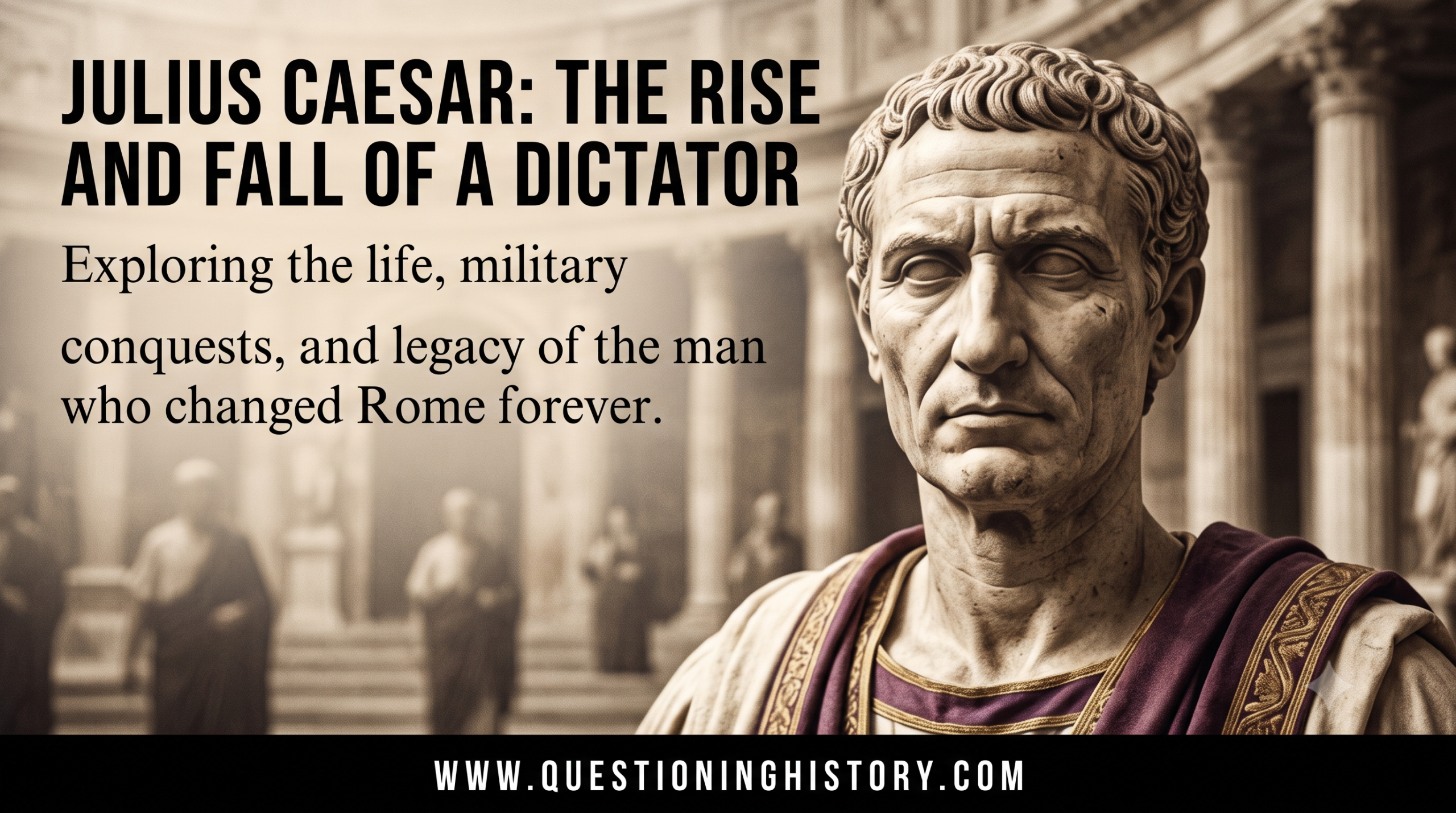
Cross-Examining the Dictator: An Exclusive Interview with Julius Caesar
The Audacity of Crossing the Rubicon
Interrogator: General Caesar, let us begin with the moment that shattered five centuries of democratic tradition. In the cold winter of 49 BCE, you stood at the banks of the Rubicon. You knew that marching your army into Italy proper would trigger a catastrophic civil war. Consequently, your actions look less like those of a patriot and more like those of a treasonous egoist. How do you justify plunging the Roman Republic into blood simply to avoid facing a courtroom?
Julius Caesar: Your question fundamentally misunderstands the reality of Roman politics. Consequently, you mistake self-preservation and the defense of the people for raw treason. The corrupt aristocratic faction in the Senate, led by Cato and Pompey, left me with zero choices. Indeed, they stripped me of my legal protections while I was still serving my country in Gaul. They actively intended to prosecute me under fabricated charges the moment I stepped across the border as a private citizen. Furthermore, they wanted to erase everything I had achieved for the common citizens. My hand was forced, Interrogator. Therefore, I chose to defend my dignity, my soldiers, and the working people of Rome from a broken, greedy oligarchy.
Interrogator: Yet, you brought an armed legion into Rome’s sacred heartland. That specific action is the definition of high treason under Roman Republic law. Therefore, your defense sounds like the classic excuse of every autocrat in history.
Julius Caesar: The law becomes a mockery when it is used as a weapon by a bankrupt elite. For many years, the Senate ignored the needs of our veterans and the poor. My march was not an assault on the Roman Republic itself. On the contrary, it was a necessary rescue mission to save our institutions from total paralysis.
The True Cost of the Gallic Conquest
Interrogator: Let us turn to your campaigns in Gaul, which you documented so carefully in your commentaries. Modern historians look at those eight years and see something far darker than a brilliant military campaign. They see a brutal campaign of mass murder. Millions of Gauls were systematically slaughtered or sold into slavery under your direct command. Thus, your vast wealth and your political ladder were built entirely on genocide. How do you look at yourself in the mirror knowing the horrific human cost of your ambition?
Julius Caesar: History is written by those who secure the borders of civilization. The tribes of Gaul posed an existential, ongoing threat to the safety of Rome. For generations, northern invaders threatened to burn our cities to the ground. Accordingly, my campaign was a preventative strategy to ensure permanent stability for our people. We brought Roman infrastructure, law, and ultimate order to a fractured, violent territory.
Interrogator: With all due respect, cutting off the hands of thousands of survivors at Uxellodunum is not bringing law. It is sheer, unadulterated terror designed to break human spirits.
Julius Caesar: Warfare requires absolute decisiveness to prevent future rebellion. By applying severe punishment to those who broke their treaties, I saved countless lives that would have been lost in endless guerrilla warfare. True leadership means making the difficult, bloody choices that ensure the ultimate survival of your state. Furthermore, the wealth gained from those victories filled the public treasury and built public works that benefit everyday Romans today.
The Mirage of Mercy and Clemenza
Interrogator: You prided yourself on your famous clementia—your policy of pardoning your Roman enemies after defeating them. However, your critics saw this as the ultimate form of psychological arrogance. By sparing men like Brutus and Cicero, you were forcing them to accept your superiority. Is it not true that your mercy was actually a calculated tool to make free Romans feel like powerless subjects?
Julius Caesar: Your cynicism is quite astonishing, Interrogator. I granted pardons because I genuinely believed in reconciliation, not because I wanted to humiliate my fellow citizens. The dictator Sulla filled the streets of Rome with blood through his horrific proscription lists. Conversely, I chose a path of peace and unity to heal our deeply fractured society. I invited my defeated adversaries back into the government because I valued their talents.
Interrogator: Clearly, that exact policy backfired spectacularly on the Ides of March. Those very men you pardoned were the ones who sharpened their daggers for you. Therefore, did your arrogance blind you to their deep resentment?
Julius Caesar: Perhaps I underestimated the deep-seated jealousy of men who preferred an outdated, broken oligarchy over genuine social progress. However, I will never regret choosing mercy over senseless cruelty. If loving my enemies was my fatal flaw, I accept that judgment proudly. I refused to rule Rome through absolute fear, even if that vulnerability eventually cost me my life.
Power, Populism, and the Dictatorship for Life
Interrogator: You continually claimed to represent the common people against the greedy aristocrats. Yet, in early 44 BCE, you had yourself named Dictator in Perpetuity. That title effectively destroyed the core principles of the Roman Republic. You became a king in everything but name, despite Rome’s ancient hatred for monarchs. Were you not just using the poor as a stepping stone to achieve total autocracy?
Julius Caesar: The old system of government was already dead long before I took supreme office. The Roman Republic was designed for a small city-state, not a massive global empire. For decades, the system produced nothing but constant gridlock, massive corruption, and regular outbreaks of civil war. The Senate proved it was completely incapable of governing justly. Therefore, centralization of authority was the only logical way to prevent total collapse.
Interrogator: That explanation sounds incredibly convenient for a man who put his own face on Roman coins. Surely, you could have reformed the system without taking absolute power for yourself.
Julius Caesar: True reform requires a strong, singular hand to cut through political corruption. During my brief time in power, I completely overhauled the calendar, adjusted unfair debts, and expanded citizenship to our provinces. I also provided land to thousands of poor veterans. These vital upgrades were consistently blocked by the Senate for decades. My absolute authority was used entirely to serve the public good, not to satisfy personal vanity.
The Sovereign Affair and the Legacy of Rome
Interrogator: Finally, let us discuss your foreign entanglements, specifically your notorious relationship with Queen Cleopatra of Egypt. You spent months dallying in Alexandria while the Roman world remained highly unstable. Your critics feared you were planning to move the capital away from Rome entirely. Were you seduced by the absolute power of an Eastern monarchy, or did you simply lose your focus?
Julius Caesar: My alliance with Egypt was a masterstroke of geopolitical strategy. Rome depended entirely on Egyptian grain to feed its growing population. By securing Cleopatra’s position on the throne, I guaranteed food security for millions of Roman citizens. Our relationship was built on mutual strategic benefit, though I admit she possesses an incredibly brilliant mind. I never had any intention of abandoning Rome or its sacred traditions.
Interrogator: Yet, your actions created a deep anxiety that fueled the conspiracy against you. Ultimately, your inability to share power led directly to your violent assassination. Was the prize of total dominance truly worth the destruction of your reputation?
Julius Caesar: My reputation is etched permanently into the foundations of western civilization. The senators thought they could save their corrupt system by driving twenty-three blades into my body. Instead, they only accelerated the inevitable transition to a more stable imperial system. My name has become synonymous with the highest level of leadership itself. Consequently, my ideas outlived my assassins, and they continue to shape the world today.
Why did the senators assassinate Julius Caesar?
Historians have long debated the exact tipping points that led to the Ides of March, but the core answer to why did the senators assassinate Julius Caesar lies in their desperate desire to preserve the Roman Republic. By 44 BCE, Caesar had accumulated unprecedented autocratic power, culminating in his appointment as dictator perpetuo (dictator in perpetuity). This lifetime appointment effectively shattered the traditional checks and balances of Rome’s governing body. The conspirators, calling themselves the Liberators, genuinely believed that by eliminating a single tyrant, they could restore constitutional rule and save their democratic institutions from total collapse.
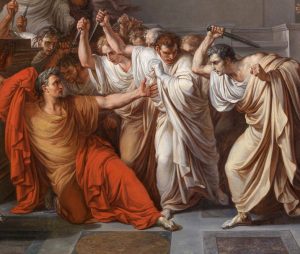
However, personal grievances and deep-seated political jealousy also heavily influenced why did the senators assassinate Julius Caesar. Beyond their philosophical devotion to the Republic, many aristocrats felt personally slighted by Caesar’s blatant disregard for senatorial prestige and his tendency to pack the senate with his own foreign loyalists. When exploring why did the senators assassinate Julius Caesar, it becomes clear that it was a volatile mix of high-minded political idealism and bitter factional resentment. Ironically, instead of reviving the Republic, their violent actions triggered a series of devastating civil wars that ultimately accelerated Rome’s transition into an autocratic empire.
Et tu Brute: The Lasting Power of History’s Most Famous Betrayal
The legendary phrase Et tu Brute remains one of the most compelling cultural symbols of ultimate betrayal and broken trust. Originally popularized by William Shakespeare in his historical tragedy Julius Caesar, this dramatic exclamation captures the exact moment the Roman dictator realizes his close friend, Marcus Junius Brutus, is among his assassins. Today, understanding the context behind Et tu Brute helps us appreciate how deeply literature can shape our collective memory of major historical turning points.
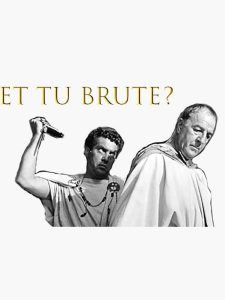
From a modern perspective, the cultural footprint of Et tu Brute extends far beyond the stage or classic literature classrooms. It has evolved into a universal shorthand used in everyday conversations, political commentary, and media to describe a shocking backstabbing by a trusted ally. By analyzing the structural impact of the narrative, we see that invoking Et tu Brute instantly evokes a powerful emotional response, proving that Shakespeare’s sharp psychological insights continue to influence contemporary language and storytelling frameworks.
Recommended Research Resources
-
The Internet Classics Archive – Caesar by Plutarch
This ancient text provides primary source biographical insights into Caesar’s character, military tactics, and personal relationships directly from antiquity.
-
Britannica – Julius Caesar Biography
An exceptionally comprehensive, peer-reviewed overview detailing the political transitions, military campaigns, and administrative reforms of the late republic.
-
World History Encyclopedia – Julius Caesar
This highly accessible, well-researched resource breaks down the complex socioeconomic factors that drove the first triumvirate and the subsequent civil war.
Disclaimer: This interview is a creative historical simulation. The responses represent what questioninghistory.com believes the historical figure may have answered based on extensive research of contemporary sources and biographical accounts.