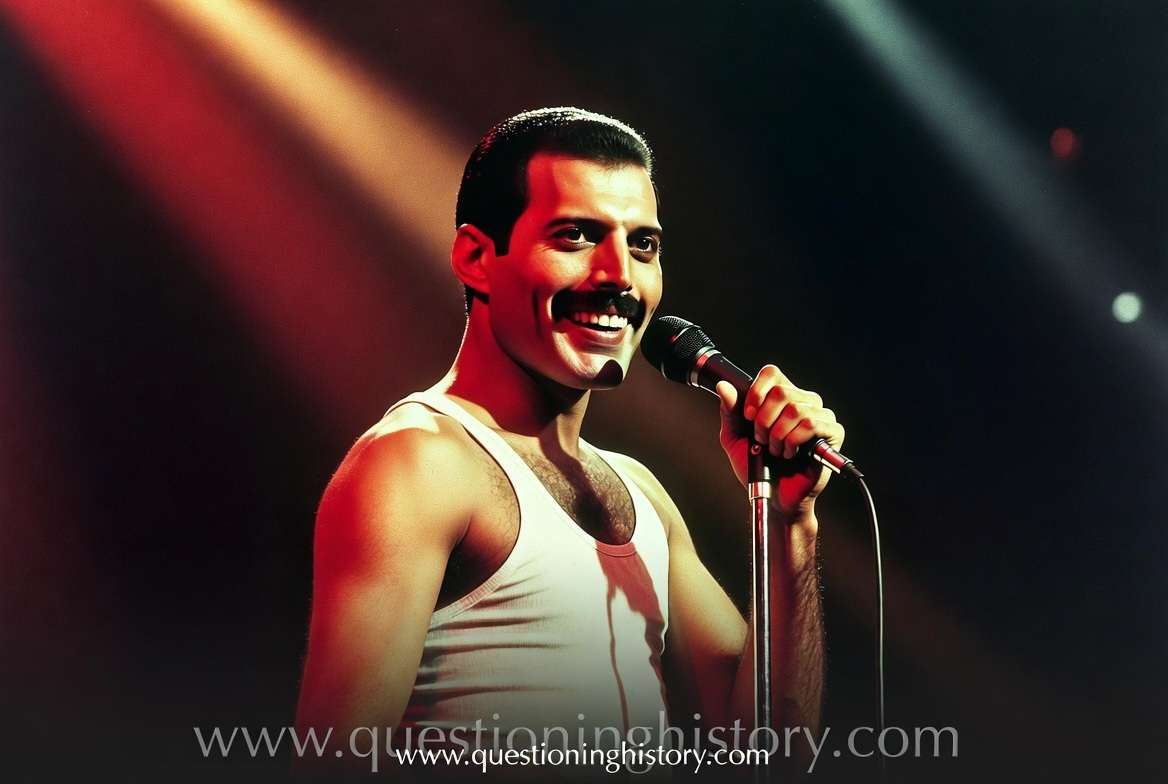
The Ultimate Showman Freddie Mercury Confronts His Legacy: An Intense, Provocative Dialogue With Rock Royalty
Few musicians have captured the imagination of the world like Queen’s frontman. And so fans of all ages continue to dissect his life, his music, and his guarded private world. In this hypothetical transcript, our tough interviewer, the interrogator, confronts the icon himself. Together, they strip away the theatrical disguise in order to reveal the vulnerable man behind the stadium anthems.
The Complex Masquerade of Rock Royalty
Interrogator: Freddie, you are universally loved for your explosive, borderline dangerous theatricality on stage. But your closest friends tend to describe you as a very shy, serene man in private. Is this flamboyant rock persona a true expression of your soul, or just a cover for Farrokh Bulsara when you don’t have trust in it?
Freddie Mercury: Oh, darling, it is absolutely a bit of both! When I walk out onto that stage in front of a hundred thousand screaming people, I become an unadulterated musical monster. So I make one of them out of sequins and adrenaline because the crowd demands a deity. In that moment, the theatricality is all real, but it is a beautiful costume that I let go of immediately after the performance is finished.
So the quiet man who retreats back to the peace of the peaceful Freddie Mercury house in Kensington is the real me. That sanctuary is where I heal, and it is where I hide from the terrifying demands of my own monumental fame. You know, nobody can survive that kind of rock-star life twenty-four hours a day without going completely insane.
Navigating Love, Loyalty, and a Sanctuary in Kensington
Interrogator: Let us discuss your complicated personal relationships, which your British tabloid press pursued with a ruthless, predatory hunger. You left your huge multi-million pound London mansion to Mary Austin, not your long-term partner Jim Hutton. Why did you choose a past romance over a current relationship, and did you want to send a message about what ultimate loyalty is?
Freddie Mercury: People love to dissect my personal decisions, but my relationship with Mary is something truly sacred that transcends human experience. She was not only physically part of me for some time after our relationship ended for some years, but she was the bedrock of my whole adult life. So when I bought the great Freddie Mercury house, which we affectionately refer to as Garden Lodge, she helped me to transform it into a place of peace for me.
Jim is an absolute saint who gave me so much happiness in our last years, and I did everything I could to make sure he was happy. But Mary was my common-law wife in every respect of the word. So leaving the beloved Freddie Mercury house to her was the ultimate fulfillment of a promise I made to her forever. She was the one who kept my deepest secrets safe when the world was trying to tear me apart.
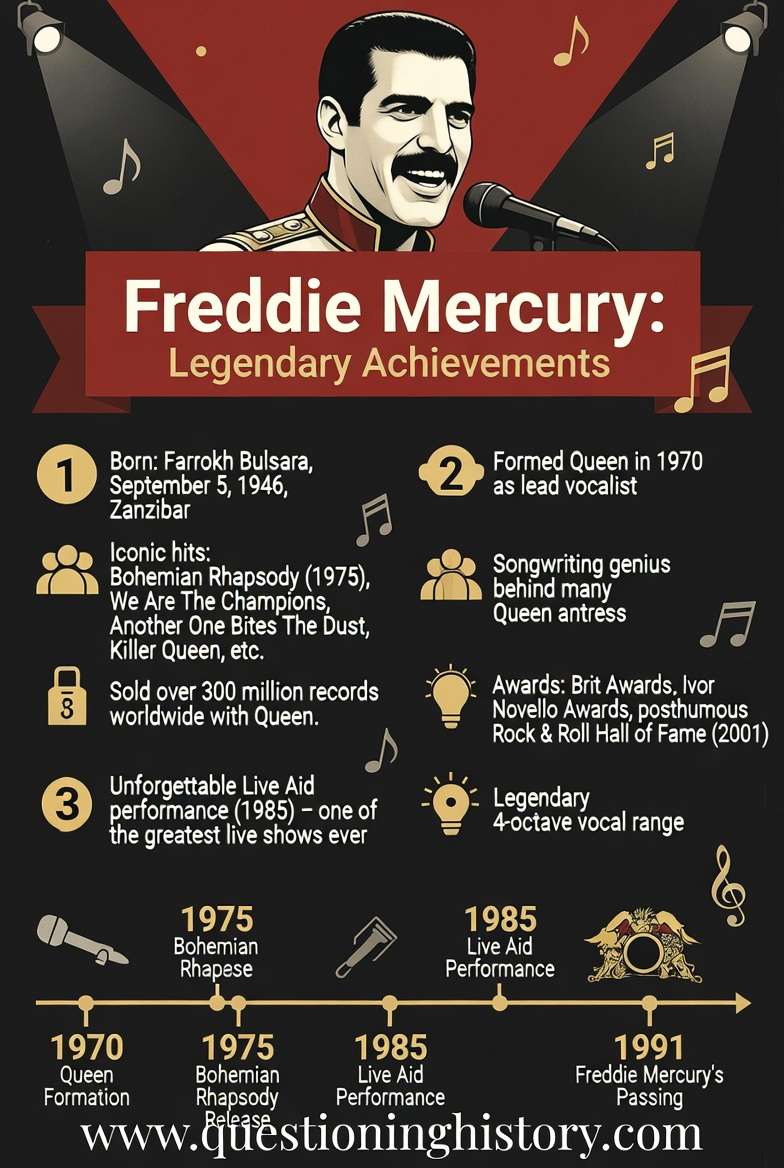
Dynamic of the Rockstar Persona | Reality of the Private Sanctuary
| Stadium crowds up to 100,000+ | Elite, private escape in London |
| Flamboyant costumes & adrenaline | Curated Japanese art collection |
| Demands of monumental fame | Surrounded by beloved cats |
The Uncompromising Rejection of Political Activism
Interrogator: During the politically charged era of the 1980s, rock music became a potent vehicle for massive social change, famously exemplified by Live Aid. Yet, you steadfastly refused to write explicitly political anthems or champion specific social movements. Do you feel that using art as a political weapon is a noble duty, or do you view it as a fundamentally pretentious distraction from pure entertainment?
Freddie Mercury: Darling, I am a musician, not a politician or a global social reformer! Some artists are perfectly suited to standing on soapboxes and lecturing their audiences, but that just makes me cringe. Because my very purpose on this planet is to give people a brief, glorious escape from their miserable daily worries, I only care about emotion.
And so, when Queen took the stage at Live Aid, we did not play to preach about the global economic situation and political gridlock. We played to obliterate the stadium’s bloody roof to bring people together and unite people with rock and roll. Politics divides people into warring factions, but a beautiful melody brings them together in joyous harmony. My music is completely timeless, and political arguments usually rot away into absolute irrelevance within a few short years.
Facing the Final Curtain With Quiet Dignity
Interrogator: The tragic reality of Freddie Mercury’s death remains one of the most poignant, intensely analyzed moments in rock history. You chose to keep your devastating HIV diagnosis from the public until just twenty-four hours before your last breath. Do you regret that level of secrecy, or do you think it was right to keep it from the world?
Freddie Mercury: I have no regrets about that decision, because my medical condition was nobody’s business but my own. At that time, the media was using the disease to dehumanize people and produce a panic. If I had announced my illness earlier, the media would have turned the Freddie Mercury house into a grotesque, daily circus of morbid exploitation.
I wanted to be remembered for my vibrant music, not for my tragic, suffering poster boy for a terrible medical disaster. So keeping the truth hidden allowed me to continue making music in the studio with my bandmates till the very end. And when the awful news of Freddie Mercury’s death finally filtered out to the world, it was delivered completely on my own precise terms.
The Eternal Legacy of a Sonic Icon
Interrogator: Since the tragic occurrence of Freddie Mercury’s death in late 1991, your monumental musical legacy has only grown more profound. The biographical film *Bohemian Rhapsody* introduced your music to an entirely new generation of global listeners. Are you happy with how history regards your art now, or do you fear that the modern media has sanitized your wild life to make it acceptable to mainstream audiences?
Freddie Mercury: Well, darling, as long as they don’t make me look boring, they can say absolutely whatever they want about my colorful life! And Hollywood movies always simplify complex realities to make them entertaining, but the core spirit of our musical journey is still very much the same. The fact that young kids are still blasting our operatic tracks in their cars today fills me with great pride. Following Freddie Mercury’s tragic death, I was told that Queen would quickly disappear into a nostalgic footnote of the eighties. But our songs are now forever woven into the very fabric of global human culture. People still sing those anthems in sports stadiums, graduation ceremonies, and random bars all around the world. And so that kind of long-term survival proves that yes we did achieve our wild dream to produce timeless art that lasts forever in our fragile human bodies.
Freddie Murcury Cats Names
What were the names of Freddie Mercury’s cats?
While Freddie Mercury is globally immortalized as the legendary, high-octane frontman of Queen, those closest to him knew a entirely different side of the rock icon—one defined by a quiet, fierce devotion to his feline companions. For Mercury, his home at Garden Lodge in London was a sanctuary away from the exhausting glare of stadium lights, and his cats were the undisputed rulers of that estate. He treated his pets not just as animals, but as genuine members of his family, providing them with a level of luxury and affection that mirrored his own grand approach to life.
Inside the Legendary Bond: How Freddie Mercury Cats Ruled Garden Lodge
The story of the Freddie Mercury cats began in the 1970s when his lifelong confidante and former partner, Mary Austin, gifted him a pair of felines named Tom and Jerry. Over the years, his family expanded significantly to include Tiffany, Dorothy, Goliath, Lily, Miko, Romeo, and his absolute favorite, Delilah. Whenever Queen was touring the globe, Mercury would regularly long-distance telephone Garden Lodge just to “speak” to his companions. Austin or his assistant would hold the receiver to the cats’ ears so they could hear his familiar voice, proving that his rock-and-roll lifestyle never compromised his role as a dedicated cat dad.
Delilah: The Feline Muse Behind a Queen Masterpiece
Among all of the famous Freddie Mercury cats, none captured his heart quite like Delilah, a large tri-color tabby adopted in the late 1980s. She slept at the foot of his bed, was the first to be fed, and even inspired a dedicated track on Queen’s 1991 album Innuendo. The song, aptly titled “Delilah,” features affectionate lyrics alongside Brian May’s guitar strings mimicking meows. While some casual listeners initially mistook the song as a tribute to a mysterious woman, true fans knew it was a pure, whimsical declaration of love to a furry companion who brought him immense comfort during his final years.
The Legacy of a Rock Icon’s Purest Affection
Even as his health declined, his deep connection with the Freddie Mercury cats remained unshakeable. In his final days, his primary focus shifted toward ensuring his beloved pets were safe, warm, and constantly cuddled. He famously left a vast portion of his fortune and his historic London mansion to Mary Austin, ensuring that the animals would continue to live out their lives in the pampered luxury they were accustomed to. Today, this unique aspect of his biography serves as a heartwarming reminder that behind the flamboyant stage presence and four-octave vocal range was a gentle soul who found his ultimate joy in the simple, unconditional love of his pets.