Napoleon Bonaparte Answers for Himself: The Interrogator Sits Down With the Emperor
Few names carry as much weight as Napoleon Bonaparte, the Corsican artillery officer who crowned himself emperor and rewrote the map of Europe. Historians still argue over when Napoleon Bonaparte ruled, how he really died, and whether he deserves to be called a hero or a tyrant. In this fictional sit-down, the Interrogator pushes past the statues and the legend to ask the questions people actually search for.
From Corsican Cadet to Emperor of the French
Napoleon’s rise wasn’t inevitable. He was a minor noble from an island France had only just annexed, and he clawed his way up through a revolution that killed men for far less ambition than his.
Interrogator: You were born on Corsica, an island France had barely absorbed. How does an outsider become emperor of the country that once viewed him with suspicion?
Napoleon: France did not hand me anything. I earned my commission at sixteen through mathematics and artillery, subjects the aristocracy considered beneath them. When the Revolution scattered the old officer class, it left room for men who could actually calculate a cannon’s trajectory. I filled that room.
Interrogator: You seized power in the coup of 18 Brumaire in 1799. Was that a rescue of France or a betrayal of the Republic you served?
Napoleon: The Directory was rotting from within — corrupt, indecisive, incapable of governing. I did not destroy a functioning republic; I replaced a failing one. History remembers the coup. It forgets the five years of chaos that preceded it.
Interrogator: So when people ask how long you actually ruled, what’s the honest answer?
Napoleon: As First Consul from 1799, then as Emperor from 1804 until my first abdication in 1814 — roughly fifteen years, with a brief and reckless return during the Hundred Days in 1815. Fifteen years reshaped more of Europe than the previous three centuries combined.
Josephine, the Crown, and a Temper Behind the Legend
Napoleon’s private life rarely matched his public image. The marriage that defined his early reign ended in divorce, and the men around him knew a very different temperament than the one carved into monuments.
Interrogator: You divorced Josephine, the woman your last words reportedly named, for a younger wife who could give you an heir. How do you defend that?
Napoleon: I do not defend it. I explain it. An empire without an heir is a temporary arrangement, and I had already watched one dynasty collapse for lack of succession. Marie Louise gave France stability. Josephine kept my affection until the day I died — both things were true at once.

Interrogator: Marshal Berthier, Talleyrand, even your own brothers — half your inner circle eventually turned on you. Were you simply impossible to work for?
Napoleon: I demanded results, not comfort. Talleyrand betrayed me because he read the wind better than I did. Berthier stayed loyal until the very end, though the strain wore on him. A man building an empire cannot afford gentle management.
Interrogator: Contemporaries described violent outbursts, thrown objects, screaming fits at generals. Was the calm, calculating image a performance?
Napoleon: The calm was for the battlefield, where panic kills men. The temper was for incompetence, which I had little patience for. I do not apologize for demanding excellence from people I trusted with an empire.
The Day an Army of Rabbits Routed an Emperor
Not every story about Napoleon involves cannons and coronations. One of the strangest — and most genuinely documented — involves a celebratory hunt that went badly wrong.
Interrogator: Let’s address the story people love most: was Napoleon Bonaparte actually attacked by rabbits?
Napoleon: Unfortunately, yes. In July 1807, my chief of staff Berthier arranged a rabbit hunt to celebrate the Treaties of Tilsit. He bought over a thousand rabbits, possibly closer to three thousand. However, he purchased farm-bred rabbits accustomed to being fed by hand, not wild ones conditioned to flee.
Interrogator: So what actually happened when the cages opened?
Napoleon: The rabbits did not scatter. They charged directly at me and my officers, expecting food. Hundreds of them swarmed our legs, climbed onto the carriages, and refused to retreat even as we fought them off. I had faced Austrian cavalry with less trouble than I faced Berthier’s rabbits that afternoon.
Interrogator: An emperor, defeated by dinner. Did your men ever let you forget it?
Napoleon: Rarely to my face. Behind my back, I imagine it became a favorite story at every officer’s table in France. I have conquered kingdoms that gave me less grief than that field of rabbits.
Empire, War, and the Rivals Who Brought It Down
Napoleon’s wars redrew Europe’s borders and cost millions of lives. Britain, Austria, Prussia, and Russia each took turns as his fiercest opponent, and one campaign in particular sealed his fate.
Interrogator: Historians still debate whether you were building an empire or feeding an addiction to war. Which is it?
Napoleon: Both accusations miss the reality. Every war I fought after 1803 was declared against me first, by coalitions determined to restore the old monarchies. I did not seek endless conflict — I responded to it, and I responded well enough to win most of it.
Interrogator: The invasion of Russia in 1812 is widely called your greatest blunder. Do you accept that verdict?
Napoleon: I accept it without hesitation. Disease and winter destroyed an army that discipline and strategy could not save. Roughly forty thousand men died to typhus alone before a single decisive battle was fought. That campaign broke the Grand Army’s spine, and everything after it was a slow collapse.
Interrogator: The Duke of Wellington eventually finished what Russia started. What did you make of him as an opponent?
Napoleon: A patient, disciplined commander who understood defense better than any general I faced. At Waterloo, he simply outlasted me. I have never denied that Wellington earned his victory.
Elba, St. Helena, and the Question of Who Napoleon Really Was
Two exiles bookended Napoleon’s fall from power, and his death on a remote Atlantic island still fuels debate two centuries later.
Interrogator: After your first defeat, you were exiled to Elba. Why did staying there for less than a year feel impossible?
Napoleon: Elba was a small, comfortable prison, and comfort has never suited me. France was in turmoil under the restored monarchy, and I still believed the French people wanted me back. For a hundred days, I was right.
Interrogator: After Waterloo, you were exiled again — this time much farther away. Where was Napoleon Bonaparte exiled to the second time, and why so remote?
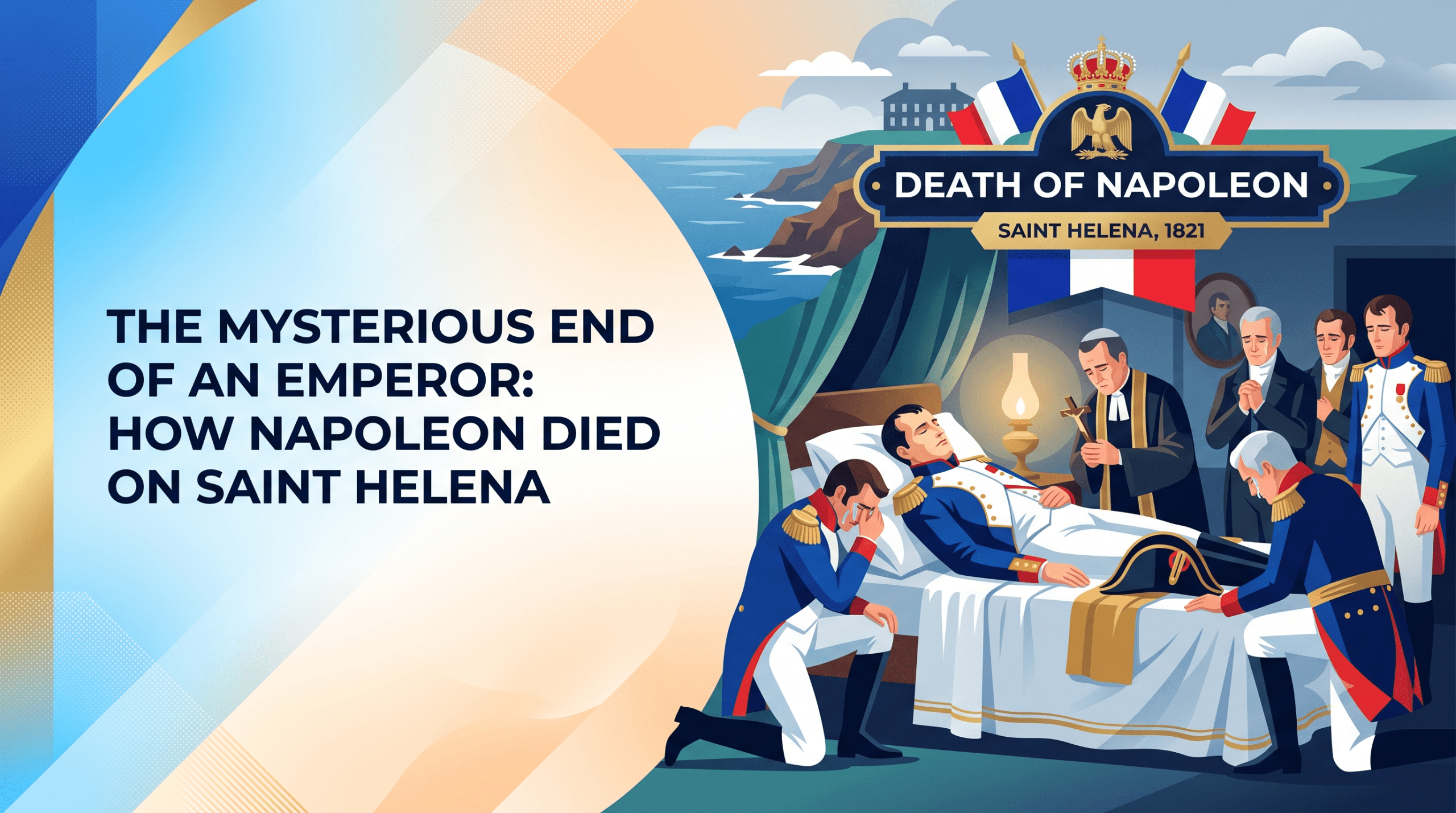
Napoleon: Saint Helena, a speck of volcanic rock in the middle of the South Atlantic, thousands of miles from any coastline I might reach. The British chose it precisely because Elba had failed to contain me. This time, there would be no third act.
Interrogator: So how did Napoleon Bonaparte actually die, given how many competing theories still circulate?
Napoleon: Stomach cancer, most likely — the same disease that killed my father. Doctors on the island diagnosed a gastric ulcer at the time, and a 2021 study by gastrointestinal pathologists confirmed cancer as the probable cause. The arsenic poisoning theory makes for better fiction than pathology; most serious historians have dismissed it.
Interrogator: Two centuries later, is Napoleon Bonaparte remembered as good or bad? Which answer would you give?
Napoleon: Neither answer alone is honest. I gave France the Napoleonic Code, a legal system that still shapes law across Europe today. I also sent hundreds of thousands of men to their deaths chasing an empire that outlived its purpose by several years. History rarely produces figures simple enough for one label, and I was never going to be the exception.
Napoleon Bonaparte’s story resists easy verdicts, and that’s precisely why it still draws readers two centuries after his death. He built an empire, lost it twice, and left behind legal reforms that outlasted every battlefield he ever commanded. Whether he deserves admiration or condemnation likely depends on which chapter of his life you’re reading.
Frequently Asked Questions About Napoleon Bonaparte
How did Napoleon Bonaparte die? Napoleon died on May 5, 1821, on the island of Saint Helena. The most widely accepted cause is stomach cancer, though poisoning theories have circulated for decades and remain largely unsupported by modern research.
Was Napoleon Bonaparte attacked by rabbits? Yes. In July 1807, a celebratory rabbit hunt organized by his chief of staff went wrong when over a thousand farm-bred rabbits swarmed Napoleon and his officers instead of fleeing, forcing them to retreat to their carriages.
Where was Napoleon Bonaparte exiled to? He was exiled twice — first to Elba in 1814, from which he escaped within a year, and then to the remote island of Saint Helena in the South Atlantic after his final defeat at Waterloo in 1815.
When did Napoleon Bonaparte rule France, and was he good or bad? He ruled as First Consul starting in 1799 and as Emperor from 1804 to 1814, with a brief return in 1815. Historians remain split on whether Napoleon Bonaparte was good or bad: he modernized French law through the Napoleonic Code, yet his wars cost millions of lives across Europe.
Disclaimer: This interview is a fictional reconstruction. It reflects what questioninghistory.com believes Napoleon Bonaparte might plausibly have said if he were alive today, based on historical research. It is not a real or verified interview.
External Links
- Britannica: Napoleon I — Exile on St. Helena — Covers Napoleon’s declining health, final months, and death in detail, drawing on contemporary accounts from Saint Helena.
- HISTORY.com: Napoleon’s Life—and Mysterious Death—in Exile — Explains the circumstances of Napoleon’s exile and the long-running debate over the true cause of his death.
- Britannica: Today in History, July 9 — Napoleon and the Rabbits — Documents the 1807 rabbit hunt incident, including firsthand accounts from officers present that day.