Name, War, and the Price of Being The Greatest
He talked before he ever threw a punch, and he never really stopped. Fans still ask why did Muhammad Ali change his name, decades after he gave his answer on national television. Tonight, he sits across from the Interrogator, and nothing is off the table.
Becoming Muhammad Ali: A New Name and a New Faith
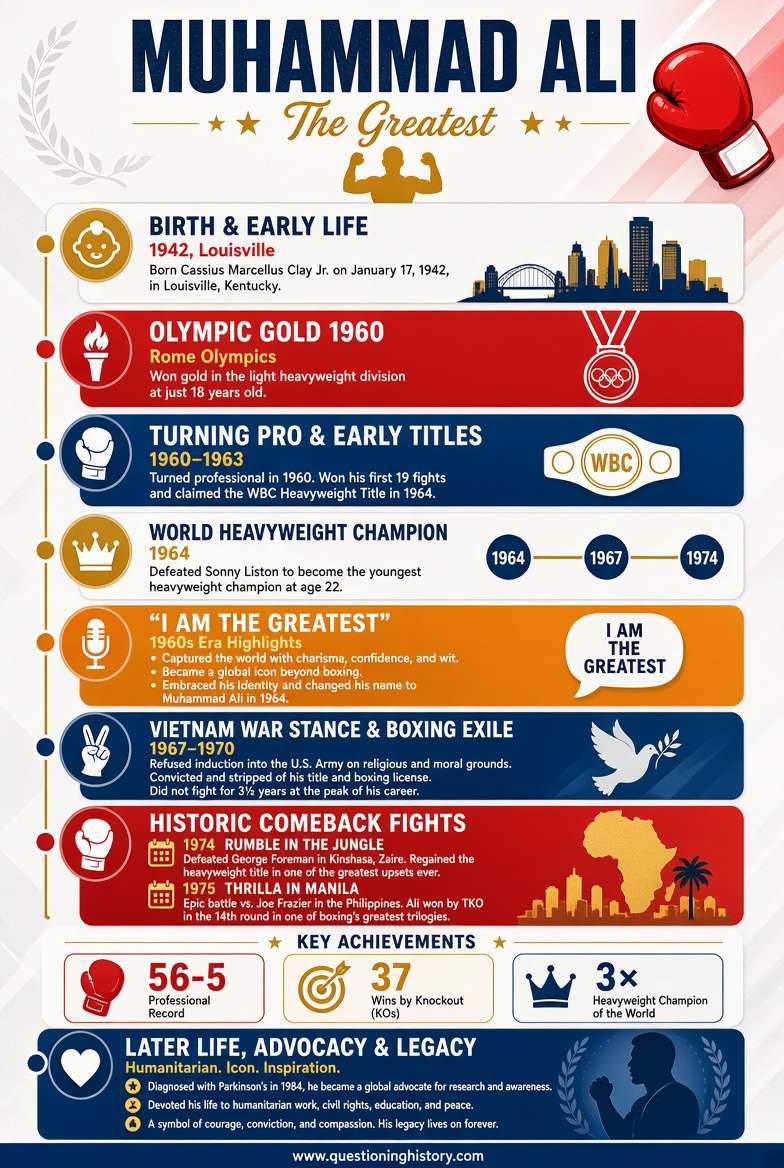
Interrogator: You beat Sonny Liston in 1964, then walked away from the name Cassius Clay almost overnight. Why did Muhammad Ali change his name at the very moment the whole country was watching?
Muhammad Ali: Cassius Clay was my slave name. I never owned it, and it never owned me. Elijah Muhammad gave me Muhammad Ali — a name that means “worthy of praise.” Even so, people ask why did Muhammad Ali change his name like it was some publicity stunt. It wasn’t. In truth, I found a faith that made sense to a Black man in America, and I took the name that came with it. No regrets. None.
Interrogator: The Nation of Islam scared plenty of white America back then, and it still divides opinion today. Even so, do you stand by that chapter of your life, even the parts that alienated people?
Muhammad Ali: I don’t apologize for wanting dignity. However, I did grow. Later, I left the Nation and moved toward orthodox Islam, then toward something quieter and more universal. Even so, some things I said in my twenties, I wouldn’t say at eighty. Meanwhile, the hunger underneath it — to be free, to be respected — never changed. That part I’d defend till my last breath.
Refusing the Draft: Faith, War, and Exile from the Ring
Interrogator: In 1967, you refused induction into the U.S. Army during the Vietnam War. That decision cost you your title, your license, and three years in your prime. Was it worth it?
Muhammad Ali: Worth it? I’d do it again tomorrow. Still, I was a conscientious objector, not a coward — my faith wouldn’t let me carry a gun for a war I didn’t believe in. Boxing could wait. My conscience couldn’t. As a result, I lost the belt, my passport, and nearly my freedom. In the end, I gained something bigger: I kept my name clean in my own eyes.
Interrogator: Critics at the time called you unpatriotic, even un-American. Some still do. So, how do you answer that charge, sitting here now?
Muhammad Ali: Patriotism isn’t blind obedience. I loved this country enough to demand it live up to its own promises. Back home, I couldn’t get served in half the restaurants in my own hometown. Therefore, sending me overseas to fight for someone else’s freedom never sat right with me. Even so, I never insulted a single soldier in Vietnam. Refusing the war was never about hating them — it was about refusing a lie.
Interrogator: Do you think the war changed how you saw America, even after the Supreme Court cleared your name in 1971?
Muhammad Ali: Absolutely, it did. The Court ruled unanimously in my favour, Clay versus the United States, and I finally got my title back in the ring. However, three years of my prime were gone forever — nobody gave those back. Since then, I’ve stopped believing the system moves fast, or fair, unless you make noise. That fight taught me patience I never had before.
Rivals in the Ring: Frazier, Foreman, and Fear
Interrogator: Your feud with Joe Frazier turned ugly. You called him ignorant, called him a tool of white America. So, did you go too far?
Muhammad Ali: Yes, I went too far, and I knew it even then. Talking trash sold tickets — that was the game, and I played it better than anyone. But Joe wasn’t a villain, he was a proud man who fought me three brutal fights. In hindsight, some of those words cut deeper than any punch I ever landed. Even now, I regret that more than people know.
Interrogator: The Rumble in the Jungle against George Foreman — nobody gave you a chance. Then, what was really going through your mind before that fight?
Muhammad Ali: Fear, honestly — real fear, not the kind I showed the cameras. George hit harder than any man alive at the time. Still, I had a plan nobody expected: lean on the ropes, let him tire himself out, then strike. From the outside, that rope-a-dope looked like madness. In truth, it was calculated, every second of it.
Marriage, Fatherhood, and Life Outside the Ropes
Boxing wasn’t the only fight in his life. Even so, people still ask how many times was Muhammad Ali married, and the answer says as much about him as any bout did.
Interrogator: So — how many times was Muhammad Ali married, and what does that history say about the man behind the fighter?
Muhammad Ali: Four times, if you’re counting — Sonji, Belinda, Veronica, and Lonnie. So that settles how many times was Muhammad Ali married, at least on paper. However, each marriage taught me something I hadn’t learned yet. Truthfully, I was better at loving people in public than being home for them. That’s the honest truth, and it’s not a proud one. Even so, Lonnie stayed with me through the hardest years, the Parkinson’s years, and she never once ran.
Interrogator: Your daughter Laila became a boxer too, against your early wishes. Even so, did you want that life for any of your kids?
Muhammad Ali: Honestly, no — I said boxing wasn’t for women, and I meant it at the time. Laila proved me wrong in the best way possible. She fought her way to an undefeated record, and I couldn’t have been prouder watching from the stands. Even so, as a father, I wanted safety for my nine kids, not scars. Yet I understood, better than anyone, why she needed to prove herself in the ring.
The Long Goodbye: Illness, Death, and What Gets Remembered
In the end, Parkinson’s took his voice long before it took his life. That’s why so many people still search for how did Muhammad Ali die and expect a simple answer.
Interrogator: By then, you had been diagnosed with Parkinson’s syndrome in 1984, not long after your final fight. How did Muhammad Ali die, in the end, and do you think boxing took more from you than it gave?
Muhammad Ali: I died on June 3, 2016, from septic shock — Parkinson’s had been wearing my body down for over thirty years by then. Even so, people ask how did Muhammad Ali die like it happened suddenly. It didn’t happen that way at all. In truth, that illness was a slow fight I couldn’t talk my way out of, and talking was the one thing I always trusted. Boxing gave me the whole world. Therefore, I won’t sit here and call it a thief, even though it cost me plenty.
Interrogator: Still, if you could go back, would you box the same way, knowing what the sport eventually took from your body and mind?
Muhammad Ali: Yes, without hesitation — boxing made me who I was. Even so, I took punches I shouldn’t have taken, especially in those last few fights past my prime. That part, I regret. Meanwhile, the man I became — bold, unbeaten in spirit, impossible to ignore — I owe entirely to that ring. Even now, I’d trade some health for that life again. Wouldn’t think twice.
Interrogator: Ultimately, how do you want to be remembered — as the greatest boxer who ever lived, or as something bigger than boxing?
Muhammad Ali: Bigger than boxing, always. Boxing was just the stage I was given. Still, what mattered more was standing up when standing up cost me everything — my title, my money, my freedom for a while. In the end, I want people to remember a man who refused to shrink himself for anybody’s comfort. That’s the whole story, in one sentence.
Closing
Sit with all of it — the name, the war, the wives, the ring, the death — and one man refuses to be simplified. He explained why did Muhammad Ali change his name, defended how many times was Muhammad Ali married, and faced how did Muhammad Ali die without flinching once. Even so, few interviews demand that much honesty. This one, at least in spirit, tried.
This interview is a fictional reconstruction. It reflects what questioninghistory.com believes Muhammad Ali might plausibly have said if he were alive today, based on historical research. It is not a real or verified interview.
C. Further Reading
- Muhammad Ali Center — The official museum and legacy foundation in Louisville, Ali’s hometown, with archival material and a timeline of his life curated by people who worked with him directly.
- Muhammad Ali biography — Britannica — A rigorously edited, fact-checked overview of his boxing record, key fights, and historical context, useful for verifying dates and outcomes.
- Clay v. United States, 403 U.S. 698 (1971) — Cornell Law School — The full text of the Supreme Court’s unanimous decision overturning his draft-evasion conviction, straight from the primary legal record.