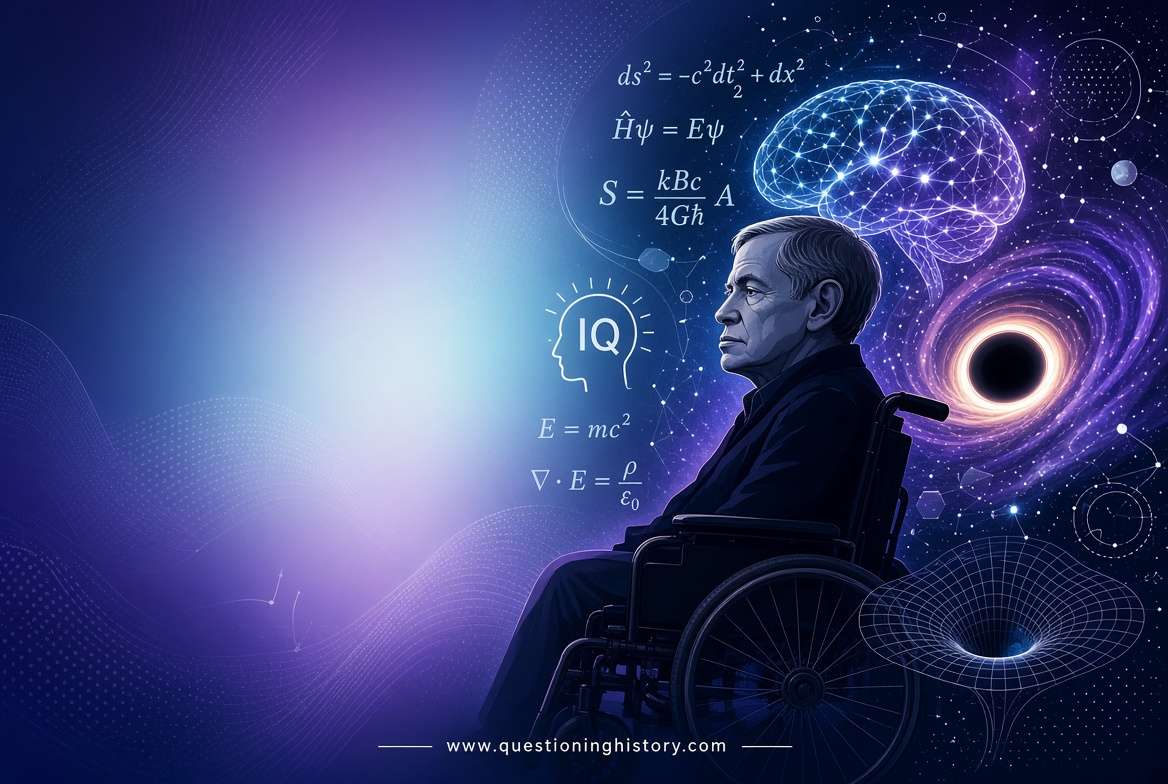
Stephen Hawking IQ 160 Faces the Interrogator: A Trapped Body and a Restless Mind
Doctors gave him two years to live in 1963. Instead, he spent the next fifty-five rewriting what we know about black holes, and he left millions asking one blunt question: did Stephen Hawking believe in God? Tonight the Interrogator wants straight answers, even if they arrive one typed word at a time.
Two Years to Live: The Diagnosis at 21
Interrogator: People still type what disease does Stephen Hawking have into Google, in the present tense, as if you never left. So tell them. What was it, and how did a 21-year-old take that news?
Stephen Hawking: Motor neurone disease. Americans call it ALS, or Lou Gehrig’s disease. It kills the nerves that move your muscles but leaves the brain alone, which is a rather cruel joke. At Oxford I’d become clumsy. I fell down some stairs and slurred the odd word. Then came tests in hospital just after my 21st birthday. A doctor gave me about two years.
Frankly, I sank into gloom. I listened to a lot of Wagner. Then something odd happened. With death pencilled into the calendar, life started to look precious. I got engaged to Jane Wilde, and suddenly I needed a job. So I started working properly for the first time.
Interrogator: When fans ask what disease does Stephen Hawking have, many assume you were born disabled. Were you?
Stephen Hawking: No. I was an ordinary, scruffy boy from St Albans who built model aeroplanes and argued with everyone. At Oxford I coxed a rowing boat. The illness crept in during my early twenties. Most people with ALS die within five years. Mine progressed unusually slowly, and doctors still can’t fully say why. Luck played its part. So did a very stubborn temper.
Genius on Paper: The IQ Question
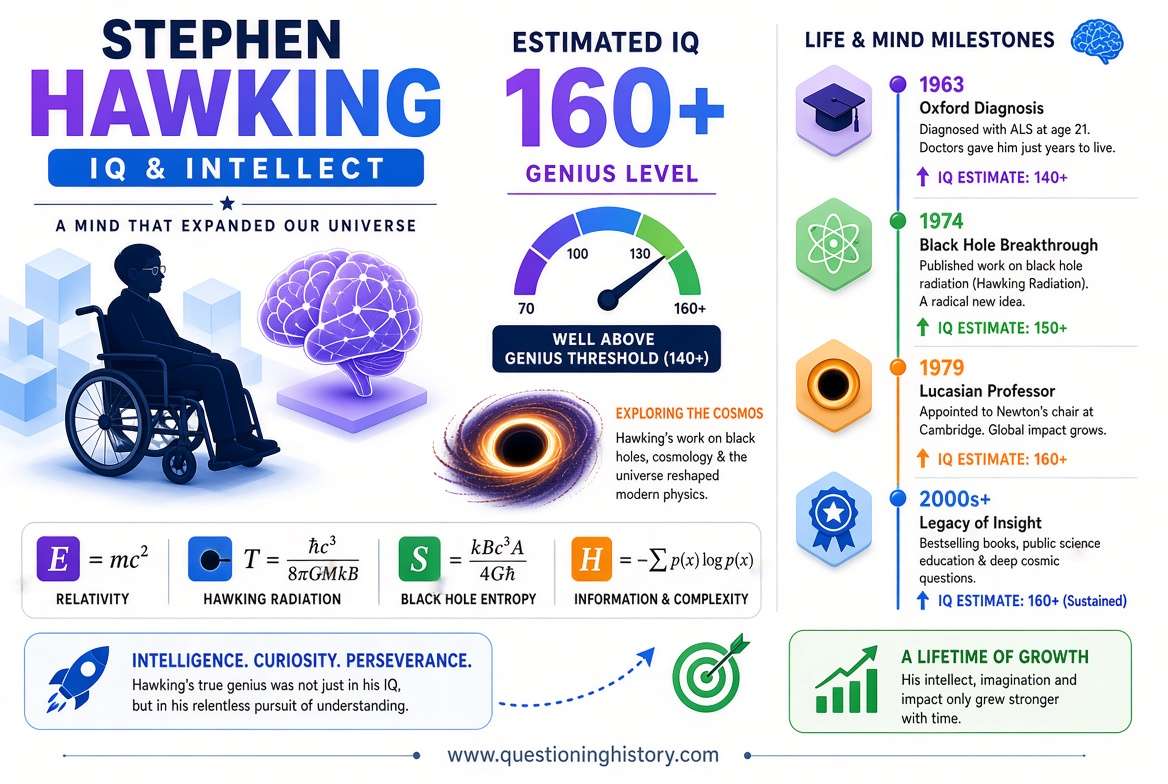
Interrogator: Let’s talk about the number everyone wants. The Stephen Hawking IQ figure quoted all over the internet is 160. Is it real?
Stephen Hawking: I have no idea. Honestly, I never took an IQ test as an adult, and I never wanted to. Someone invented that number, and websites copy it from each other like schoolboys cheating in an exam. When a reporter once asked me, I said people who boast about their IQ are losers. I still think so.
Interrogator: Then what made you different? Because you weren’t exactly a model student.
Stephen Hawking: Hardly. My school marks were roughly average, though my classmates nicknamed me Einstein. Perhaps they saw something. At Oxford I worked about an hour a day. By my own count, that came to roughly a thousand hours in three years. My final exam put me on the line between a first and a second. So the examiners called me in. I told them that if they gave me a first, I’d go to Cambridge. If they gave me a second, I’d stay at Oxford. They gave me a first.
Interrogator: If the Stephen Hawking IQ score is fiction, why do people cling to it so hard?
Stephen Hawking: Because a number is easier than an idea. People see the wheelchair, then the brain, and they want a tidy myth. However, I made plenty of mistakes. I also never won a Nobel Prize. Physics rewards things you can prove in a lab, and nobody has yet caught a black hole glowing.
Black Holes, Bets and Bruised Egos
Interrogator: In 1974 you announced that black holes aren’t completely black. Many physicists thought you were wrong. Were they?
Stephen Hawking: At first, I thought I was wrong too. The maths kept telling me that black holes should leak a faint glow and slowly shrink. Eventually I stopped fighting the equations. Today that glow carries my name, Hawking radiation. Meanwhile, the argument it started, about what happens to information that falls in, ran for thirty years.
Interrogator: You lost some famous bets along the way. Which one hurt?
Stephen Hawking: None of them hurt much. I bet Kip Thorne that Cygnus X-1 wasn’t a black hole, as an insurance policy against my own life’s work. Naturally, I lost, and he got a magazine subscription his wife didn’t approve of. In 2004 I conceded the information bet to John Preskill and gave him a baseball encyclopedia. Later, I lost a hundred dollars when the Higgs boson turned up. Peter Higgs had grumbled that my fame gave my opinions more weight than they deserved. On that one, he may have had a point.
God, Faith and a Universe That Needs No Maker
Interrogator: Your 1988 bestseller ended by saying we might one day “know the mind of God.” So be honest. Did Stephen Hawking believe in God?
Stephen Hawking: No. That line was a figure of speech, and it sold a lot of books. What I meant was that we would understand everything a God would understand, if there were one. I don’t think there is. In The Grand Design, I argued that the laws of physics allow a universe to start itself. You don’t need someone to light the blue touch paper. Later I said it plainly: I’m an atheist.
Interrogator: Your first wife, Jane, was a committed Christian. People who ask did Stephen Hawking believe in God often want to know what that did to your marriage. So what did it do?
Stephen Hawking: It didn’t help. Jane’s faith kept her going through years of nursing me while raising three children. My certainty probably felt like a quiet insult to her. Still, faith wasn’t the only strain. Fame, exhaustion and the presence of carers in our home all played their part. We separated in 1990 and divorced in 1995. Later that year, I married Elaine Mason, one of my nurses. That marriage ended in 2006. Jane and I became friends again, which says more about her than about me.
The Voice, the Final Years and Legacy
Interrogator: Millions of people know your voice before they know your work. How did Stephen Hawking talk after losing his own?
Stephen Hawking: In 1985 I caught pneumonia in Geneva. A tracheotomy saved my life but took my voice. For a while, I spelled words by raising my eyebrows at letters on a card. Then a computer program arrived that let me pick words with a hand clicker. Later, when my hand failed, a sensor on my glasses read twitches in my cheek. The voice itself came from an old synthesiser with an American accent. People offered me newer, smoother voices. I refused. By then it was mine.
Interrogator: You died on 14 March 2018, aged 76. People search for Stephen Hawking last words and find nothing. Why?
Stephen Hawking: Because there’s nothing grand on record. I died peacefully at home in Cambridge, and my family kept those final hours private, as they should. My last science paper, written with Thomas Hertog, was finished not long before. Afterwards my ashes went into Westminster Abbey, not far from Newton and Darwin. For a boy who barely revised, that’s decent company.
Interrogator: Last question. How do you want to be remembered: as a genius in a wheelchair, or something else?
Stephen Hawking: As a scientist first. The wheelchair was a fact, not a personality. I’d like people to remember that black holes taught us something new about the universe. Above all, I’d like them to stay curious. At the 2012 Paralympics I asked people to look up at the stars and not down at their feet. I’ll stand by that, so to speak.
Closing
So the record is set straight. The famous Stephen Hawking IQ number was never his. Meanwhile, the answer to what disease does Stephen Hawking have was ALS, which he outlived by half a century. As for whether did Stephen Hawking believe in God, he answered that himself, without hedging. Agree with him or not, few minds ever argued so hard from so still a body.
Frequently Asked Questions
What is the Stephen Hawking IQ score?
There is no verified Stephen Hawking IQ score. The popular figure of 160 has no reliable source, and Hawking said he had no idea what his IQ was. He also dismissed people who boast about theirs.
What disease does Stephen Hawking have?
Hawking had motor neurone disease, also called ALS. He was diagnosed in 1963, aged 21, and given about two years to live. He lived with the illness for 55 years until his death on 14 March 2018.
Did Stephen Hawking believe in God?
No. In his later books and interviews, Hawking said the laws of physics could explain how the universe began without a creator. He described himself as an atheist. His famous “mind of God” line from 1988 was a figure of speech.
How did Stephen Hawking talk after losing his voice?
After a 1985 tracheotomy, Hawking used a speech synthesiser controlled by computer. At first he chose words with a hand clicker. Later, an infrared sensor on his glasses detected movements in his cheek muscle.
C. Further Reading
- Stephen Hawking — Britannica — An edited, fact-checked biography covering his black hole research, books and honours. It’s the quickest way to verify dates and achievements.
- Stephen Hawking — Westminster Abbey — The Abbey’s own page on his memorial, including where his ashes lie and the Hawking radiation equation carved on his stone.
- Stephen Hawking Estate — Official Site — The official site run by his estate, with his biography, books, public speeches and lectures in one place.
This interview is a fictional reconstruction. It reflects what questioninghistory.com believes Stephen Hawking might plausibly have said if he were alive today, based on historical research. It is not a real or verified interview.